
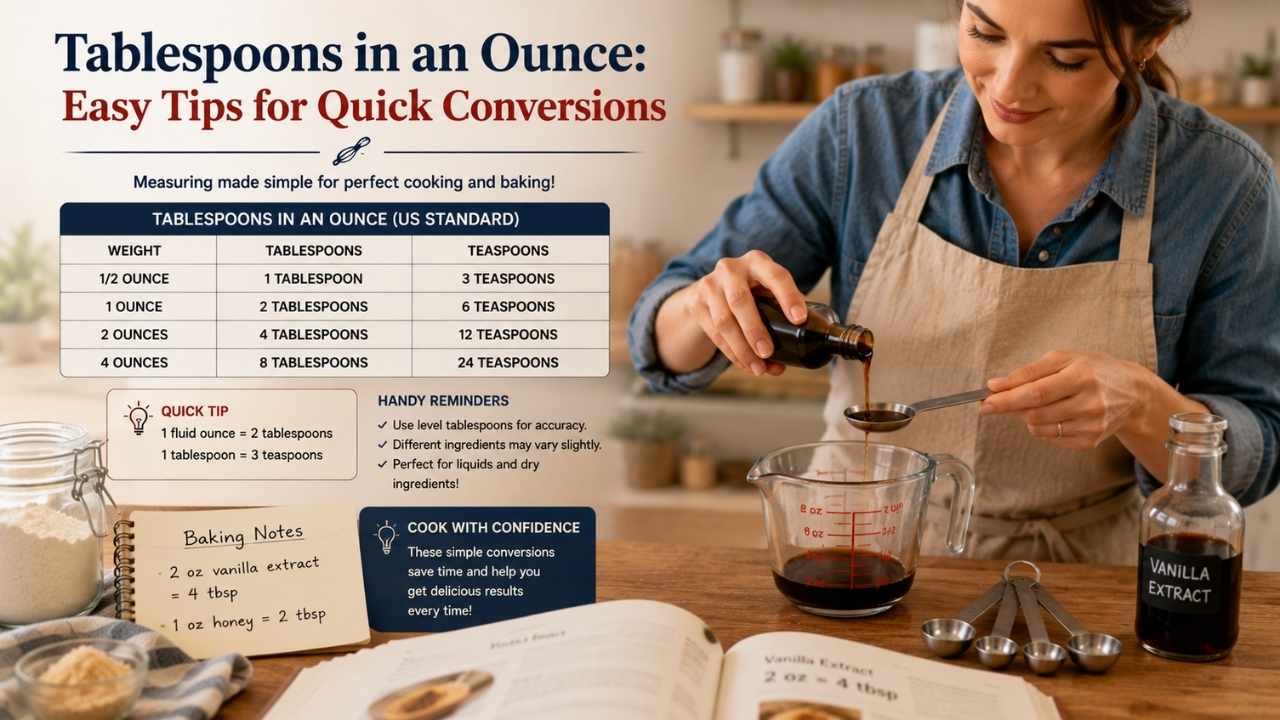
Have you ever followed a recipe and wondered how many tablespoons are in an ounce? You are not alone! Measuring ingredients can feel confusing, especially when a recipe uses ounces instead of tablespoons. Luckily, converting these kitchen measurements is simple once you know the basic rule.
One US fluid ounce equals 2 tablespoons. This easy conversion helps you measure water, milk, oil, and other liquids without guesswork. You can also use an ounces-to-tablespoons conversion chart to find the amounts you need for cooking and baking.
However, it is important to understand the difference between fluid ounces and ounces by weight. Fluid ounces measure volume, while weight ounces measure mass. Knowing this difference helps you follow recipes accurately and get better results in your kitchen.
Quick Answer
One US fluid ounce equals 2 US tablespoons. To convert fluid ounces to tablespoons, multiply the number of fluid ounces by two. For example, 4 fluid ounces equal 8 tablespoons. Remember, this rule applies to volume measurements, not every ingredient measured by weight.
How Many Tablespoons Are in 1 Ounce?
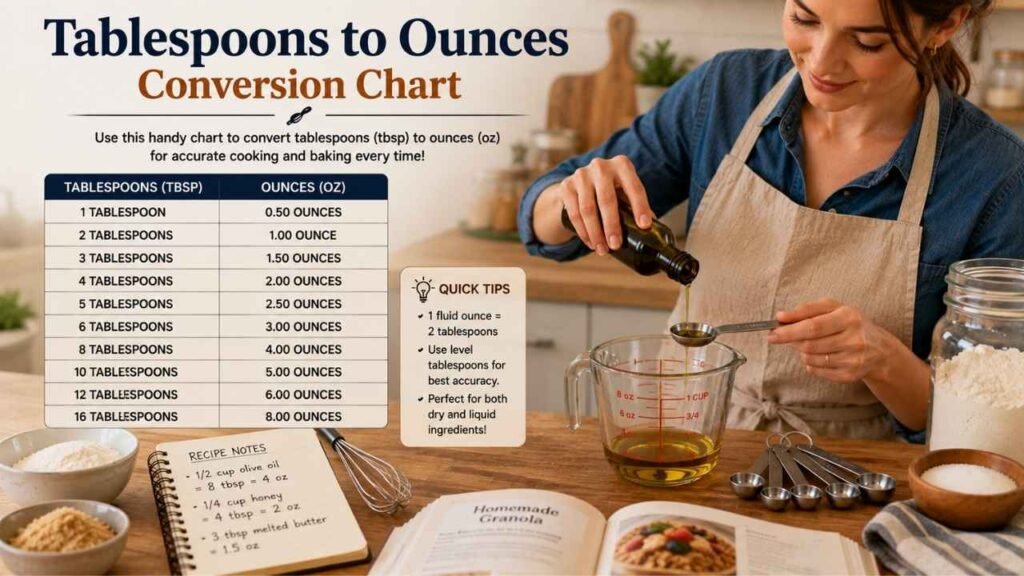
There are 2 US tablespoons in 1 US fluid ounce. This is one of the most useful kitchen measurement conversions because many recipes list liquids in ounces while measuring spoons use tablespoons.
For example, if your recipe needs 2 fluid ounces of milk, you can measure 4 tablespoons instead. Similarly, 3 fluid ounces of water equal 6 tablespoons. These simple calculations make cooking and baking easier when you do not have a liquid measuring cup nearby.
However, 1 ounce does not always equal 2 tablespoons. The rule works for US fluid ounces, which measure volume. An ounce by weight measures mass, so the tablespoon equivalent depends on the ingredient. Always check which type of ounce your recipe uses.
Ounces to Tablespoons Conversion Chart
A conversion chart helps you find the right measurement without doing the math each time. The table below uses US fluid ounces and standard US tablespoons, making it useful for everyday cooking and baking.
| US fluid ounces | US tablespoons | US cups |
| ¼ fl oz | ½ tbsp | 1/32 cup |
| ½ fl oz | 1 tbsp | 1/16 cup |
| 1 fl oz | 2 tbsp | ⅛ cup |
| 2 fl oz | 4 tbsp | ¼ cup |
| 3 fl oz | 6 tbsp | ⅜ cup |
| 4 fl oz | 8 tbsp | ½ cup |
| 6 fl oz | 12 tbsp | ¾ cup |
| 8 fl oz | 16 tbsp | 1 cup |
| 12 fl oz | 24 tbsp | 1½ cups |
For example, 2 oz to tablespoons gives 4 tablespoons, while 8 oz to tablespoons gives 16 tablespoons. These values work for fluid ounces, not ounces by weight.
How to Convert Ounces to Tablespoons
Converting ounces to tablespoons is easy once you know the formula. For US fluid ounces, simply multiply the number of ounces by 2. This gives you the number of tablespoons needed for your recipe.
Formula:
Tablespoons = Fluid ounces × 2
For example, 3 fluid ounces × 2 = 6 tablespoons. If you need 5 fluid ounces of milk, multiply 5 by 2 to get 10 tablespoons. This method works for any US fluid-ounce amount.
You can also convert tablespoons back to fluid ounces. Simply divide the number of tablespoons by 2. For instance, 12 tablespoons ÷ 2 = 6 fluid ounces. These easy formulas help you adjust recipes, measure liquids, and avoid unnecessary guesswork.
Fluid Ounces vs. Ounces by Weight
Although both measurements use the word ounce, they do not measure the same thing. A fluid ounce (fl oz) measures volume, which means how much space a liquid takes up. A regular ounce by weight measures mass.
One US fluid ounce equals 2 US tablespoons. However, one ounce by weight of flour, sugar, or butter does not automatically equal 2 tablespoons. Each ingredient has a different density, so the amount of space it occupies can vary.
For accurate cooking and baking, check whether your recipe lists fluid ounces or weight ounces. A kitchen scale is usually the best choice when a recipe gives ingredients in ounces by weight. Measuring spoons work well for volume, but they cannot replace weight measurements for every ingredient.
How Many Tablespoons Are in an Ounce of Common Ingredients?
The answer depends on whether your recipe measures an ingredient by volume or weight. For liquids, the standard US fluid-ounce conversion is straightforward: 1 fluid ounce equals 2 tablespoons. This works for water, milk, oil, and similar liquids when measured by volume.
Dry ingredients are different. One ounce by weight of flour may take up a different volume than one ounce by weight of sugar. Honey, peanut butter, and butter also have their own weight-to-volume relationships. Their tablespoon amounts should not be calculated using the fluid-ounce rule alone.
If you need an accurate ingredient conversion, look for a trusted ingredient-specific chart or weigh the ingredient using a kitchen scale. This is especially helpful when baking, where small measurement changes can affect the final texture and result.
Tablespoon and Ounce Measurements Around the World
Not every country uses the same kitchen measurements. In the United States, 1 US tablespoon is approximately 14.79 milliliters, and 1 US fluid ounce is approximately 29.57 milliliters. This is why one US fluid ounce equals two US tablespoons.
In many recipes, a metric tablespoon is 15 milliliters. Australian tablespoons are commonly 20 milliliters, so conversions can differ depending on the recipe. A tablespoon measurement from one country may not match another exactly.
Fluid ounces can also vary between US and Imperial systems. An Imperial fluid ounce is larger than a US fluid ounce. If you are using an international recipe, check the measurement system before converting ounces to tablespoons. This small step helps prevent mistakes and keeps your cooking results more consistent.
FAQs
How many tablespoons are in 2 ounces?
2 US fluid ounces equal 4 US tablespoons. Multiply 2 by 2 to get the answer. If the ounces refer to weight, the result depends on the ingredient.
How many tablespoons are in 4 ounces?
4 US fluid ounces equal 8 tablespoons, or half a US cup. This conversion is useful when measuring milk, water, or other liquids.
How many tablespoons are in 8 fluid ounces?
8 US fluid ounces equal 16 tablespoons, which is the same as 1 US cup. This is a common conversion in cooking and baking.
How many tablespoons are in half an ounce?
Half a US fluid ounce equals 1 US tablespoon. Divide 0.5 by the conversion amount of one-half fluid ounce per tablespoon, or simply remember that half a fluid ounce is one tablespoon.
Can I use a regular eating spoon to measure a tablespoon?
A regular eating spoon may hold more or less than a standard tablespoon. For better accuracy, use a standard measuring spoon, especially when baking or following a recipe that needs precise amounts.
Conclusion
Knowing how many tablespoons are in an ounce makes everyday cooking and baking much easier. The main rule is simple: 1 US fluid ounce equals 2 US tablespoons. Multiply fluid ounces by two to convert them to tablespoons, or divide tablespoons by two to convert them back.
Remember that fluid ounces measure volume, while ounces by weight measure mass. This difference matters when working with flour, sugar, butter, and other solid ingredients. Use ingredient-specific conversions or a kitchen scale when accuracy is important.
Keep the conversion chart handy whenever you follow a recipe. With these simple formulas and measurement tips, you can convert kitchen measurements confidently and spend less time calculating and more time enjoying your food.