
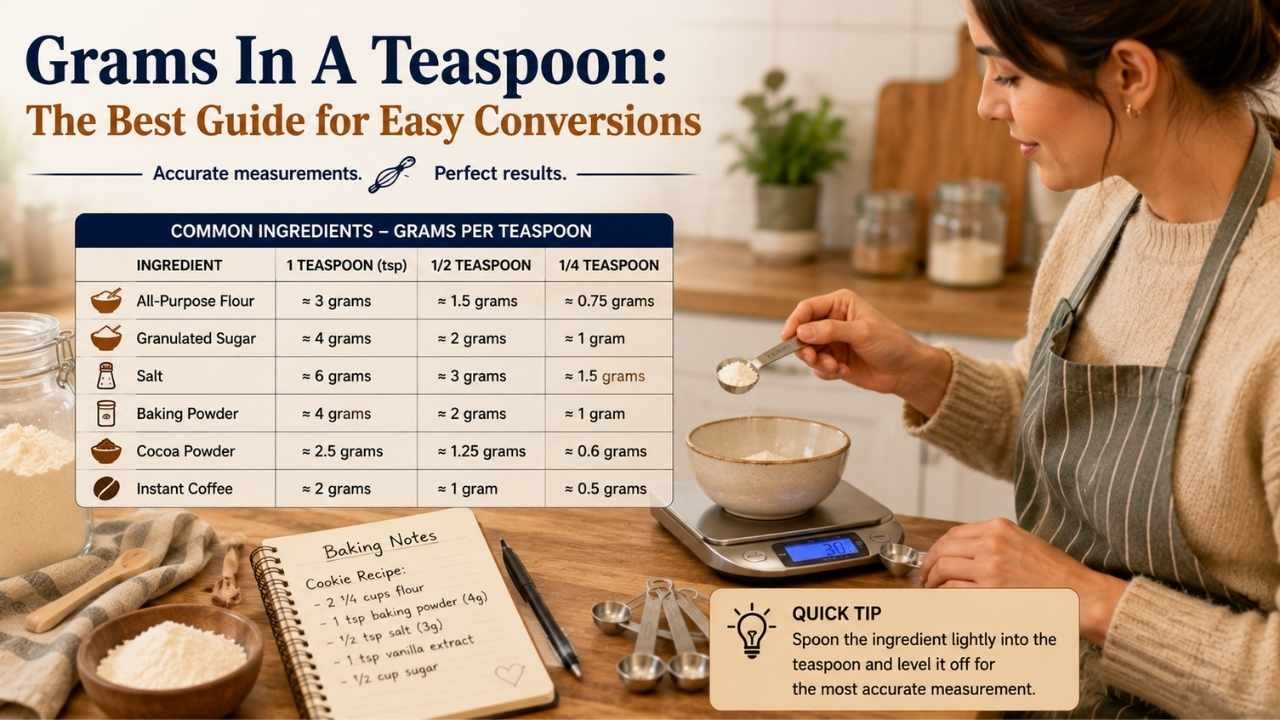
If you are following a recipe and wondering how many grams are in a teaspoon, you are not alone. A teaspoon measures volume, while grams measure weight, so the answer changes depending on the ingredient. A teaspoon of flour, sugar, salt, or honey will not weigh the same.
This teaspoon to grams conversion guide makes cooking and baking measurements easier. You will find a simple grams in a teaspoon conversion table for common ingredients, along with useful conversions for ¼, ½, and 2 teaspoons.
You will also learn why ingredient density matters, how to convert teaspoons to grams, and how to measure ingredients more accurately. Whether you are baking a cake or preparing dinner, this guide will help you measure ingredients with less guesswork.
Quick Answer
There is no single gram value for every teaspoon. One US teaspoon holds about 4.93 milliliters, but its weight depends on the ingredient. For example, one teaspoon of water weighs about 4.9 grams, granulated sugar about 4.2 grams, and all-purpose flour about 2.5–2.7 grams. For accurate results, use an ingredient-specific conversion table or a kitchen scale.
How Many Grams Are in 1 Teaspoon?
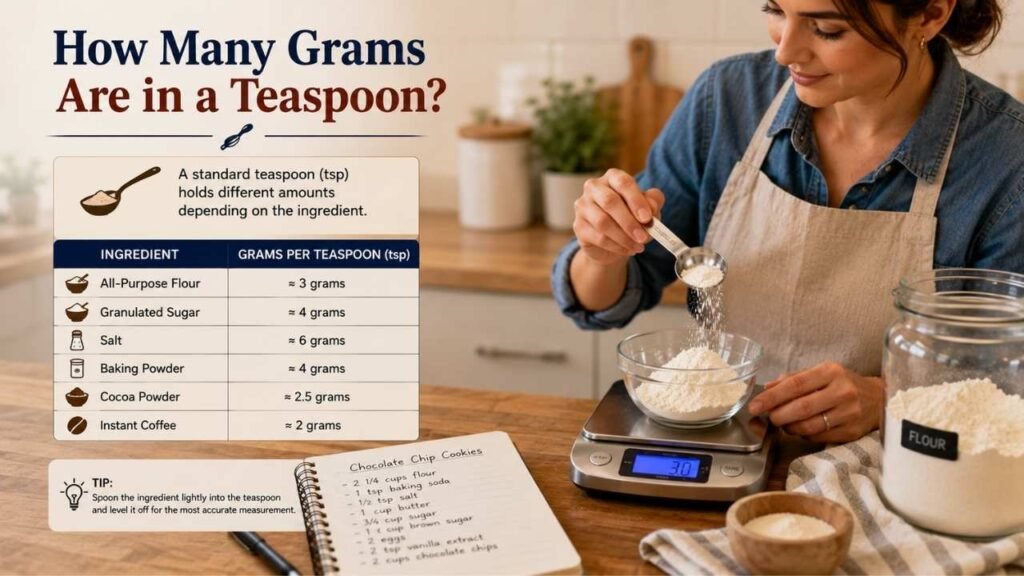
The number of grams in 1 teaspoon depends on the ingredient you measure. A teaspoon measures space, while grams tell you how much something weighs. This is why equal spoonfuls of different ingredients can have different weights.
For example, one teaspoon of water weighs about 4.9 grams, while one teaspoon of all-purpose flour weighs around 2.5–2.7 grams. Granulated sugar weighs approximately 4.2 grams per teaspoon, and table salt weighs about 6 grams.
These figures are useful estimates for everyday cooking. However, ingredient type, packing, and preparation can change the final weight. When a recipe needs exact measurements, checking the ingredient’s weight with a kitchen scale is the most reliable option.
Teaspoons to Grams Conversion Table for Common Ingredients
Use this teaspoons to grams conversion table to find approximate weights for popular cooking and baking ingredients. The values below are for one level US teaspoon, where practical, and can vary by brand and preparation.
| Ingredient | Approx. grams per teaspoon |
| Water | 4.9 g |
| Granulated sugar | 4.2 g |
| Brown sugar, packed | 4.6 g |
| Powdered sugar | 2.5–2.8 g |
| All-purpose flour | 2.5–2.7 g |
| Table salt | 6 g |
| Baking powder | 4 g |
| Baking soda | 4.8–6 g |
| Butter | 4.7 g |
| Olive oil | 4.5 g |
| Honey | 7 g |
| Milk | 5.1 g |
| Cornstarch | 2.5–2.7 g |
| Cocoa powder | 1.8–2.5 g |
| Active dry yeast | 3.1 g |
| Ground cinnamon | About 2.6 g |
These are approximate values, not universal measurements. For the best results, use the same reference consistently and weigh ingredients when precision matters.
Teaspoon to Gram Conversions for Different Ingredients
Sugar and Sweeteners
Sugar weights depend on the type and how tightly it is packed. One level teaspoon of granulated sugar weighs about 4.2 grams, while powdered sugar weighs around 2.5–2.8 grams. Packed brown sugar is approximately 4.6 grams per teaspoon.
Honey is heavier, at about 7 grams per teaspoon. Maple syrup also weighs more than granulated sugar in the same volume, although the exact value depends on the product.
These differences matter when preparing desserts, sauces, or drinks. If you need a precise amount, use a scale instead of assuming every sweetener has the same grams-per-teaspoon value.
Flour and Baking Ingredients
One teaspoon of all-purpose flour weighs approximately 2.5–2.7 grams. The exact weight can change if the flour is sifted, packed, or scooped directly from the bag. Different flour types can also have different weights.
Baking powder usually weighs around 4 grams per teaspoon. Baking soda may weigh approximately 4.8–6 grams, depending on the reference and how it is measured. Active dry yeast weighs roughly 3.1 grams per teaspoon.
For reliable baking, measure flour and other dry ingredients consistently. A kitchen scale is especially useful for recipes that depend on accurate ingredient ratios.
Salt, Spices, and Liquids
Salt can weigh more per teaspoon than many other dry ingredients. One teaspoon of table salt is approximately 6 grams, but kosher salt and coarse sea salt may weigh much less because their crystals are larger and leave more empty space in the spoon.
Ground cinnamon weighs around 2.6 grams per teaspoon, although the value can vary. Water weighs about 4.9 grams, milk about 5.1 grams, and olive oil around 4.5 grams per teaspoon.
Always consider the type of ingredient before using a conversion. Different textures and densities lead to different weights, even when the spoon size stays the same.
Teaspoons to Grams for Different Amounts
Once you know the weight of one teaspoon of an ingredient, you can estimate the weight of smaller or larger amounts. The key is to multiply the ingredient’s grams-per-teaspoon value by the amount used.
For example, if one teaspoon of granulated sugar weighs about 4.2 grams, half a teaspoon weighs about 2.1 grams. Two teaspoons weigh about 8.4 grams, while three teaspoons weigh about 12.6 grams.
| Amount | Sugar, approximately |
| ⅛ teaspoon | 0.5 g |
| ¼ teaspoon | 1.1 g |
| ½ teaspoon | 2.1 g |
| ¾ teaspoon | 3.2 g |
| 1 teaspoon | 4.2 g |
| 1½ teaspoons | 6.3 g |
| 2 teaspoons | 8.4 g |
| 3 teaspoons | 12.6 g |
| 4 teaspoons | 16.8 g |
These figures are rounded estimates. The same amounts will have different gram weights for flour, salt, honey, and other ingredients.
How to Convert Teaspoons to Grams
You can convert teaspoons to grams with a simple formula:
Grams = teaspoons × grams per teaspoon
First, find the approximate weight of one teaspoon of your ingredient. Next, multiply that value by the number of teaspoons in your recipe. For example, if one teaspoon of sugar weighs 4.2 grams, three teaspoons weigh 3 × 4.2 = 12.6 grams.
For flour, using an estimate of 2.6 grams per teaspoon, two teaspoons weigh about 5.2 grams. This method works for other ingredients as long as you use the correct ingredient-specific value. It is an easy way to handle cooking conversions without needing a complicated calculator.
Why Do Grams per Teaspoon Change by Ingredient?
The main reason is density. Density describes how much matter fits into a certain amount of space. A teaspoon holds the same volume, but different ingredients fill that space in different ways.
For example, honey is dense and weighs more than flour in the same teaspoon. Flour is light and contains air between its particles, so a level teaspoon weighs much less. Salt crystals also vary in size, which changes how much salt fits inside a spoon.
Packing and preparation matter, too. Pressed brown sugar weighs more than loosely filled brown sugar. Sifted flour may weigh less than flour packed into the spoon. This is why a single universal teaspoon-to-gram conversion does not work for every ingredient.
US Teaspoon vs. Metric Teaspoon
A US customary teaspoon holds approximately 4.93 milliliters, while a metric teaspoon holds 5 milliliters. The difference is small, so both are often treated as equivalent for everyday cooking.
However, accurate measurements can matter in baking, where small changes may affect the final texture. The weight of the ingredient still depends on its density, so a 5 mL teaspoon does not automatically equal 5 grams.
For consistency, check which teaspoon standard your recipe uses and apply it throughout your measurements. The conversion table in this article uses approximate weights for a level US teaspoon. If a recipe gives ingredient amounts in grams, weighing them directly is usually more accurate than converting from volume.
How Ingredient Preparation Affects Weight
The way you fill a teaspoon can change the weight of an ingredient. A level teaspoon has its contents even with the rim, while a heaped teaspoon contains extra material above the rim. These measurements should not be treated as equal.
Packing also matters. Brown sugar is often pressed into a measuring spoon, while flour is usually measured without pressing it down. Scooping flour directly from a bag may pack more into the spoon than gently spooning it in.
Liquids should be measured with an appropriate measuring spoon and filled carefully. Solid butter and melted butter can also behave differently when measured by volume. For better results, follow the recipe’s measuring instructions and use a kitchen scale whenever precise weights are available.
Tips for Measuring Ingredients Accurately
A few simple habits can make cooking and baking measurements more reliable. First, use a proper measuring teaspoon rather than an ordinary eating spoon, which may hold a different amount. For dry ingredients, fill the spoon and level the top when the recipe calls for a level teaspoon.
Second, use an ingredient-specific grams-to-teaspoons conversion rather than assuming every ingredient weighs the same. Keep in mind that flour, sugar, salt, and liquids have different weights even when their measured volumes match.
Finally, use a digital kitchen scale for recipes that need precision. Weighing ingredients reduces errors caused by packing, spoon size, and texture. If a conversion table gives a range, treat it as an estimate rather than an exact value. Consistent measuring helps you get more dependable results.
FAQs
Is 1 teaspoon always 5 grams?
No. A teaspoon measures volume, while grams measure weight. One teaspoon of water weighs about 4.9 grams, but sugar weighs around 4.2 grams and flour around 2.5–2.7 grams.
How many grams are in 1 teaspoon of sugar?
One level US teaspoon of granulated sugar weighs approximately 4.2 grams. Powdered and brown sugar can have different weights.
How many grams are in 1 teaspoon of flour?
One level teaspoon of all-purpose flour weighs about 2.5–2.7 grams. Packing and flour type can affect the result.
How many grams are in ½ teaspoon?
The weight depends on the ingredient. For granulated sugar, half a teaspoon weighs about 2.1 grams. For other ingredients, use half of the relevant one-teaspoon estimate.
How many teaspoons are in a gram?
There is no single answer for all ingredients. Divide one gram by the ingredient’s approximate grams-per-teaspoon value to estimate the volume. For example, one gram of granulated sugar is about 0.24 teaspoon.
Can I convert grams to teaspoons without a kitchen scale?
Yes, if you have a reliable ingredient-specific conversion table. However, a kitchen scale is more accurate, especially for baking and small quantities.
Conclusion
Knowing how many grams are in a teaspoon makes recipes easier to follow, but the right conversion depends on the ingredient. Sugar, flour, salt, liquids, and baking ingredients all have different weights, even when measured with the same spoon.
Use the conversion table as a quick reference, follow consistent measuring methods, and remember that ingredient density and packing can affect the result. For everyday cooking, approximate values are often enough. For precise baking, weighing ingredients with a kitchen scale is the better choice.
With the right conversion and a little care, you can measure ingredients more confidently and get more consistent results in your kitchen.