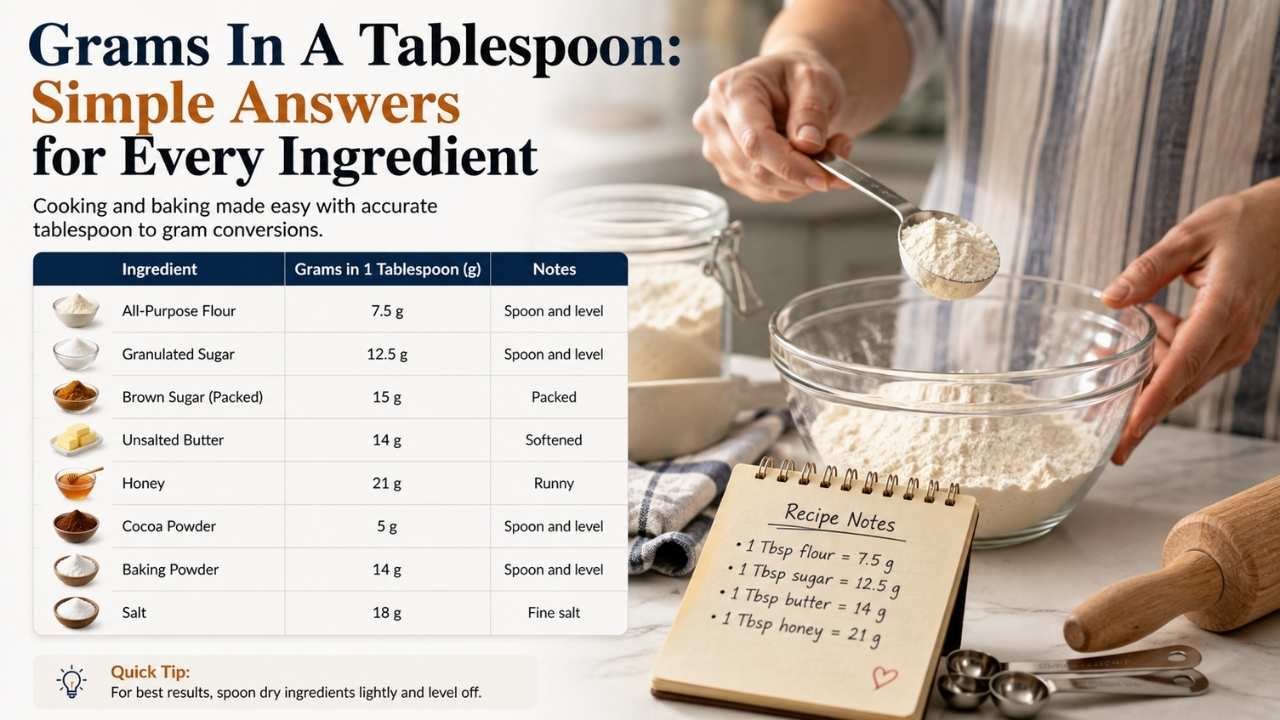
Grams In A Tablespoon: Simple Answers for Every Ingredient 

Wondering how many grams are in a tablespoon? The answer depends on the ingredient you are measuring. A tablespoon measures volume, while grams measure weight, so there is no single conversion that works for every ingredient. For example, 1 tablespoon of water is about 15 grams, while flour, sugar, butter, and honey have different weights.

This tablespoon to grams guide makes common cooking and baking conversions simple. You’ll find a useful tablespoon conversion chart, ingredient-specific measurements, and easy ways to convert tablespoons to grams or grams to tablespoons. We’ll also explain why ingredient density, measuring methods, and tablespoon sizes can affect the result.

Whether you need 1 tablespoon to grams, are converting several tablespoons, or simply want more accurate recipe measurements, this guide will help. For the best accuracy, especially when baking, a kitchen scale is often the most reliable choice.

Quick Answer

There is no single number of grams in a tablespoon because the weight depends on the ingredient. As a quick guide, 1 tablespoon of water is about 15 grams, flour is about 8 grams, sugar about 12.5 grams, butter about 14 grams, and honey about 21 grams. A tablespoon measures volume, while grams measure weight, so always check the specific ingredient for a more accurate conversion.

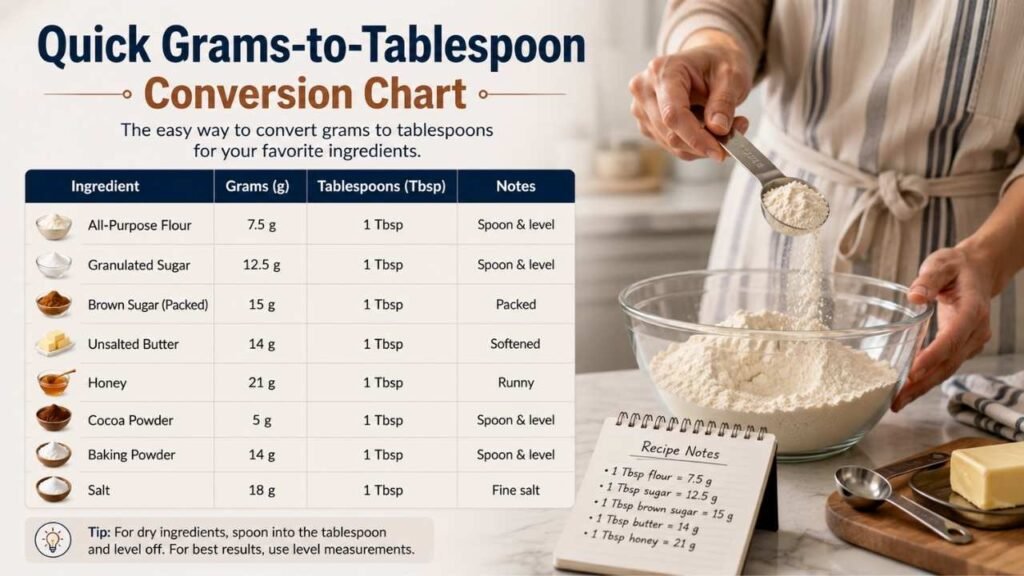
Quick Grams-to-Tablespoon Conversion Chart

Quick Grams-to-Tablespoon Conversion Chart

A tablespoon to grams conversion depends on the ingredient. This is because different foods have different weights even when they fill the same spoon. The table below gives useful approximate values for common cooking and baking ingredients.

For example, 1 tablespoon of water is about 15 grams, while 1 tablespoon of flour is only about 8 grams. Sugar, butter, and honey also have different values. These numbers are helpful for everyday recipes, but they should not be treated as exact laboratory measurements.

The way an ingredient is filled into the spoon can also change its weight. For better results, use a level tablespoon instead of a heaping one. If a recipe needs high accuracy, especially baking recipes, a kitchen scale is a better choice. Always check the ingredient before using a general grams per tablespoon conversion.

Common Dry Ingredients

Dry ingredients can have very different weights in one tablespoon. Flour, for example, is light and usually weighs around 8 grams per tablespoon. Granulated sugar is heavier and weighs about 12.5 grams. Brown sugar can weigh more when it is packed tightly, while powdered sugar is lighter because of its fine texture. Cocoa powder, cornstarch, baking powder, and salt also have their own approximate values.

 When measuring dry ingredients, use a level tablespoon for better consistency. Do not press flour or cocoa powder into the spoon unless the recipe specifically says to do so. Scooping directly from a container can also add extra weight. For baking, measuring dry ingredients by grams with a kitchen scale gives more reliable results than using tablespoons alone.

Common Wet Ingredients

Liquid ingredients are often easier to measure with tablespoons, but their gram weights still vary. Water is a useful reference because 1 tablespoon is about 15 grams. Milk is also close to this amount, while oils are slightly lighter. Honey and maple syrup are much heavier because they are denser liquids.

 This means you cannot assume that every liquid tablespoon equals 15 grams. For example, a tablespoon of honey can weigh around 21 grams. When using a tablespoon to grams conversion, always check the ingredient first. A measuring spoon is useful for small amounts in everyday cooking, sauces, and drinks.

 However, if a recipe requires exact amounts, especially for baking, weighing the ingredient is better. The values in a conversion chart should therefore be treated as approximate measurements, not fixed rules.

Common Fats and Spreads

Fats and spreads also have different weights when measured by tablespoon. Butter is a common example, with 1 tablespoon weighing about 14 grams. Peanut butter, shortening, cream cheese, and similar ingredients can have different values because their density and texture are not the same.

 The way you fill the spoon can also affect the final weight. A level tablespoon gives a more consistent result than a rounded or heaping spoon. For solid butter, the measurement can also depend on whether it is cold, softened, or melted. A recipe may specify the form it needs, so follow those instructions carefully. If you need to convert grams to tablespoons, first identify the exact ingredient. Using one general conversion for all fats and spreads can lead to an incorrect amount.

Why Do Grams in a Tablespoon Vary by Ingredient?

The main reason is simple: grams measure weight, while tablespoons measure volume. A tablespoon tells you how much space an ingredient takes up, but grams tell you how heavy it is. Different ingredients have different densities, so they do not all weigh the same when placed in the same tablespoon.

 For example, 1 tablespoon of flour is about 8 grams, while the same volume of honey can be around 21 grams. This is why saying 1 tablespoon equals 15 grams is only a useful shortcut for some ingredients, not a universal rule.

 The ingredient’s texture, density, preparation, and measuring method can all affect its weight. When converting tablespoons to grams, always use a value made for the specific ingredient. This simple idea will help you avoid many common cooking measurement mistakes.

How Many Grams in a Tablespoon of Flour?

1 tablespoon of all-purpose flour is about 8 grams, although the exact amount can vary. Flour is light, so it weighs much less than sugar or honey in the same tablespoon. The measuring method also matters. If you scoop flour directly from a bag or container, you may pack more flour into the spoon and increase the weight.

 For a more consistent measurement, gently spoon the flour into the measuring spoon and level the top with a straight edge. This is often called the spoon-and-level method. Bread flour and whole-wheat flour may have slightly different weights because their texture and density can vary. If a recipe gives flour in grams, using a kitchen scale is the best choice. For quick cooking, however, a level tablespoon is a useful estimate.

How Many Grams in a Tablespoon of Sugar?

The answer depends on the type of sugar. 1 tablespoon of granulated sugar is about 12.5 grams. Brown sugar can weigh more when it is firmly packed, while powdered sugar is usually lighter because it contains more air between its fine particles. This is why you should not use one sugar conversion for every type.

 If a recipe simply says sugar, it usually means the type listed in the ingredient list. When measuring granulated sugar, fill the tablespoon and level it for a consistent amount. For brown sugar, follow the recipe if it says packed brown sugar.

If you need an exact amount, measuring sugar in grams with a kitchen scale is more reliable. These simple differences explain why grams in a tablespoon of sugar can change from one type to another.

How Many Grams in a Tablespoon of Butter?

1 tablespoon of butter is about 14 grams. This is a useful conversion for recipes that provide butter in tablespoons instead of grams. However, the form of butter matters. A tablespoon of solid butter, softened butter, or melted butter may be measured differently depending on the recipe instructions.

 If a recipe tells you to melt the butter first, follow that step before measuring when instructed. For solid butter, many packaged sticks also have tablespoon markings, making measurement easier. When converting tablespoons to grams, remember that butter has a different density from water, flour, and sugar.

 Therefore, you should not use the common 15-gram shortcut for every ingredient. For baking, a kitchen scale can provide a more accurate butter-to-gram conversion and help keep the recipe consistent.

How Many Grams in a Tablespoon of Honey?

1 tablespoon of honey is about 21 grams, making honey much heavier than flour or water in the same spoon. This happens because honey is a dense, thick liquid. Its sticky texture can also make measuring a little harder. When using honey in a tablespoon, allow it to settle into the spoon rather than leaving a large amount stuck to the sides.

 Some cooks lightly coat the spoon with oil or water to help sticky ingredients slide out more easily, depending on the recipe. If you need an exact amount, weighing honey can be easier and cleaner. The important point is that 1 tablespoon of honey is not 15 grams. When using a tablespoon to grams conversion, always use the value for honey rather than a general liquid conversion.

How Many Grams in a Tablespoon of Water?

1 tablespoon of water is about 15 grams when using a standard 15 mL tablespoon. Water is often used as the simple example when explaining the relationship between tablespoons, milliliters, and grams. However, this does not mean that every liquid or ingredient will have the same weight.

 Oil, milk, honey, and other liquids have different densities, so their gram values can vary. If your recipe calls for a tablespoon of water, a standard measuring spoon gives a practical result.

For very accurate work, you can also weigh the water. When converting 1 tablespoon to grams, make sure you know which ingredient you are measuring. The 15-gram value is a useful reference for water, but it should not be used as a universal tablespoon conversion for all foods.

How Many Grams in a Tablespoon of Oil?

The weight of oil depends slightly on the type, but 1 tablespoon of cooking oil is generally around 13–14 grams. Olive oil and vegetable oil can have slightly different weights because their densities are not exactly the same. This is why a tablespoon of oil should not automatically be treated as 15 grams. When measuring oil for cooking, fill the tablespoon carefully and avoid spilling or leaving a large amount behind.

For everyday recipes, a measuring spoon is usually accurate enough. If you are tracking exact ingredient amounts or working with a baking recipe, weighing the oil can provide better consistency.

When searching for grams in a tablespoon of oil, always check the specific oil when precision matters. A small difference may not matter in simple cooking, but it can matter more in carefully balanced recipes.

How Many Grams in a Tablespoon of Salt?

Salt can vary in weight depending on its type and crystal size. A tablespoon of fine table salt can weigh considerably more than the same volume of coarse salt because the crystals are different. This means there is no single salt value that works perfectly for every type. If a recipe uses table salt, use a level tablespoon for a more consistent measurement.

 If it calls for kosher or coarse salt, follow the recipe’s specific instructions because different brands can also have different crystal sizes. For precise cooking or baking, weighing salt in grams is the safest option.

When using a salt tablespoon-to-gram conversion, always identify the salt type first. This is another good example of why ingredient-specific conversions are more reliable than simply assuming 1 tablespoon equals 15 grams.

How to Convert Tablespoons to Grams

To convert tablespoons to grams, you need two pieces of information: the number of tablespoons and the ingredient’s approximate grams per tablespoon. The simple formula is:

Grams = tablespoons × grams per tablespoon

For example, if 1 tablespoon of granulated sugar weighs about 12.5 grams, then 2 tablespoons would be about 25 grams. If 1 tablespoon of flour weighs about 8 grams, then 3 tablespoons would be about 24 grams. The key is to use the correct value for the ingredient. You cannot use the sugar value when converting flour or the water value when converting honey.

This makes an ingredient-specific tablespoon conversion chart very useful. For everyday cooking, approximate values are usually enough. For baking and recipes that need precision, use a kitchen scale whenever possible.

Example: Convert 2 Tablespoons of Sugar to Grams

Suppose you need to convert 2 tablespoons of granulated sugar to grams. A tablespoon of granulated sugar weighs about 12.5 grams. To find the weight of 2 tablespoons, multiply the amount by the grams per tablespoon:

2 × 12.5 = 25 grams

So, 2 tablespoons of granulated sugar are about 25 grams. This example shows how simple a tablespoon-to-gram conversion can be when you know the ingredient’s approximate weight. The same method can be used for flour, butter, honey, water, and other ingredients.

Just remember that each ingredient has its own value. You should not use 12.5 grams as the standard for every food. If the recipe gives a specific gram amount, follow that amount whenever possible. For greater accuracy, especially in baking, weigh the sugar with a kitchen scale instead of relying only on a measuring spoon.

Example: Convert 3 Tablespoons of Flour to Grams

If 1 tablespoon of all-purpose flour is about 8 grams, you can easily estimate the weight of 3 tablespoons. Use the basic conversion:

3 × 8 = 24 grams

So, 3 tablespoons of flour are approximately 24 grams when using a level tablespoon. This is only an estimate because flour can become packed during measuring. A heaping spoon can contain much more flour than a level spoon. For this reason, the way you measure flour matters. The spoon-and-level method gives a more consistent result than scooping and pressing flour into the spoon.

If your recipe gives flour in grams, use a kitchen scale for the best accuracy. This example also shows why there is no universal tablespoon to gram conversion. Three tablespoons of flour, sugar, butter, and honey will all have different gram weights.

Example: Convert 4 Tablespoons of Butter to Grams

Butter is commonly measured in tablespoons, so this conversion is useful in many recipes. If 1 tablespoon of butter is about 14 grams, then 4 tablespoons can be estimated as:

4 × 14 = 56 grams

Therefore, 4 tablespoons of butter are about 56 grams. The exact result may vary slightly depending on the butter and how it is measured. If the recipe asks for solid butter, measure it in that form. If it asks for melted butter, follow the recipe’s instructions carefully because the measurement method can be different.

For regular cooking, this simple conversion is usually practical. For baking, where small differences can affect the final texture, weighing butter in grams is a better choice. When using a butter tablespoon-to-gram conversion, always check whether the recipe means solid, softened, or melted butter.

Common Tablespoon-to-Gram Conversions

There are several tablespoon amounts that appear often in recipes. However, the number of grams still depends on the ingredient. For example, ½ tablespoon of water is about 7.5 grams, while ½ tablespoon of honey is about 10.5 grams.

 Similarly, 2 tablespoons of sugar are about 25 grams, while 2 tablespoons of flour are around 16 grams. This is why a useful conversion guide should always name the ingredient. Common quantities include ¼ tablespoon, ½ tablespoon, 1 tablespoon, 2 tablespoons, 3 tablespoons, and 4 tablespoons.

For quick cooking, you can multiply the ingredient’s one-tablespoon value by the number of tablespoons. If accuracy is important, especially with baking ingredients, use a scale. Never assume that every tablespoon amount can be converted using the same 15-gram rule.

How Many Grams Are in ¼ Tablespoon?

A ¼ tablespoon is one-fourth of a tablespoon, but its gram weight depends on the ingredient. For example, if 1 tablespoon of water is about 15 grams, then ¼ tablespoon of water is about 3.75 grams.

 If you are measuring flour, sugar, butter, or honey, the answer will be different. Very small amounts can also be difficult to measure accurately with a standard tablespoon because most measuring spoon sets do not include a ¼ tablespoon.

 You may need to use a smaller spoon or a kitchen scale. For recipes where precision matters, especially baking, weighing the ingredient is usually better. When converting ¼ tablespoon to grams, first find the grams-per-tablespoon value for the specific ingredient, then divide it by four.

How Many Grams Are in ½ Tablespoon?

A ½ tablespoon is half of one tablespoon. Its gram weight changes depending on what you are measuring. For example, ½ tablespoon of water is about 7.5 grams, while ½ tablespoon of granulated sugar is about 6.25 grams. Half a tablespoon of flour would be around 4 grams, based on an approximate 8-gram tablespoon.

 These values are useful for quick recipe adjustments, but they are still estimates. To calculate the amount yourself, simply divide the ingredient’s one-tablespoon weight by two.

A measuring spoon can work well for everyday cooking, while a kitchen scale is better for very precise amounts. Remember that ½ tablespoon to grams is not one fixed conversion. Always identify the ingredient before deciding on the gram value.

How Many Grams Are in 1 Tablespoon?

There is no universal gram weight for 1 tablespoon. The answer depends on the ingredient. A standard 15 mL tablespoon of water is about 15 grams, while flour is around 8 grams, granulated sugar about 12.5 grams, butter about 14 grams, and honey around 21 grams.

This difference happens because a tablespoon measures volume and grams measure weight. The ingredient’s density determines how much it weighs inside the spoon.

 When a recipe says 1 tablespoon, it normally refers to the volume measurement, not a fixed number of grams. If you need to replace tablespoons with grams, find the correct value for that ingredient first. This is especially important for baking, where accurate measurements can affect the final result. A kitchen scale provides the most reliable measurement.

How Many Grams Are in 2 Tablespoons?

The answer for 2 tablespoons depends on the ingredient. For example, 2 tablespoons of water are about 30 grams, while 2 tablespoons of granulated sugar are about 25 grams. Two tablespoons of flour are around 16 grams, butter around 28 grams, and honey around 42 grams.

 These examples show why you should never use one general number for every food. To calculate 2 tablespoons, simply multiply the ingredient’s one-tablespoon weight by two. If you have a recipe that gives measurements in tablespoons but you prefer grams, this method makes the conversion easy.

 For everyday cooking, approximate values are usually fine. For baking, a kitchen scale is recommended because small differences in flour, sugar, and other ingredients can change the final texture and result.

How Many Grams Are in 3 Tablespoons?

Three tablespoons contain three times the amount found in one tablespoon, but the final gram weight still depends on the ingredient. For example, 3 tablespoons of water are about 45 grams, while 3 tablespoons of granulated sugar are about 37.5 grams. Three tablespoons of flour are around 24 grams, and 3 tablespoons of honey are around 63 grams.

 To make the conversion, multiply the ingredient’s one-tablespoon weight by three. This is a simple way to handle 3 tablespoons to grams without using a complicated formula. Remember that these numbers are approximate.

Ingredient density, preparation, and measuring technique can affect the result. If the recipe requires exact measurements, especially for baking, use a kitchen scale. It will give you a more consistent result than a spoon alone.

How Many Grams Are in 4 Tablespoons?

The gram weight of 4 tablespoons changes according to the ingredient. Four tablespoons of water are about 60 grams, while four tablespoons of granulated sugar are around 50 grams.

Four tablespoons of flour are about 32 grams, and four tablespoons of butter are around 56 grams. To convert any ingredient, multiply its approximate one-tablespoon weight by four. This makes the process simple and useful when adjusting recipes.

 However, remember that the result is based on an approximate ingredient value. A packed tablespoon of brown sugar or a heaping tablespoon of flour can weigh more than a level spoon. If you are scaling a baking recipe, using a kitchen scale is the better option. For normal cooking, these tablespoon-to-gram estimates are usually practical enough.

Is 1 Tablespoon Always 15 mL?

A tablespoon is commonly treated as 15 mL in the United States, but tablespoon sizes can differ between countries. This matters because the volume of the spoon affects the final gram weight.

A metric tablespoon is commonly 20 mL, while an Australian tablespoon is also 20 mL. If you use a different tablespoon standard from the one used by a recipe, your measurement may not match exactly.

 This is especially important when converting tablespoons to grams, because the starting volume is different. For this guide, the common 15 mL tablespoon is used unless stated otherwise. When following an international recipe, check which measurement system it uses. This small detail can prevent confusion when a recipe gives tablespoons instead of grams or milliliters.

US Tablespoon vs. Metric Tablespoon vs. Australian Tablespoon

Not every tablespoon has exactly the same volume around the world. A US tablespoon is commonly 15 mL, while a metric tablespoon is generally 20 mL. An Australian tablespoon is also 20 mL. This difference may seem small, but it can affect ingredient conversions, especially when several tablespoons are used. 

For example, a 20 mL tablespoon contains more volume than a 15 mL tablespoon, so it can also contain more grams of the same ingredient. When using a tablespoon to grams converter, always check the tablespoon standard behind the calculation.

If you are writing or following a recipe, clearly stating the measurement standard makes the instructions easier to understand. For consistency, the main conversion values in this guide use a standard 15 mL tablespoon.

Level vs. Heaping Tablespoon: Does It Change the Grams?

Yes, a level tablespoon and a heaping tablespoon do not contain the same amount. A level tablespoon is filled to the top and then flattened, while a heaping or rounded tablespoon has extra ingredient above the edge. This difference can be small for some foods but quite large for light ingredients such as flour or cocoa powder. 

When a recipe simply says “1 tablespoon,” it usually refers to a standard level measuring spoon unless the recipe gives different instructions. For accurate cooking, especially baking, avoid guessing with a large heap. Use a level spoon or, even better, weigh the ingredient.

This is one reason why grams per tablespoon should be treated as an approximate value. The amount can change based on how tightly or loosely an ingredient is placed in the spoon.

Does the Way You Measure an Ingredient Affect Its Weight?

Yes. Measuring technique can change the weight even when you use the same tablespoon. Flour is a good example. Scooping flour directly from a container can press it together and give you more flour than the spoon-and-level method. Brown sugar is often intentionally packed because recipes may require a firm measurement.

Sticky foods such as honey can also leave some of the ingredient behind in the spoon. The ingredient’s form matters too. Butter may be solid, softened, or melted, and the recipe may require one specific form.

For the most consistent results, follow the recipe’s measuring instructions. If a recipe gives a weight in grams, use a kitchen scale whenever possible. These small details explain why tablespoon-to-gram conversions are best treated as useful estimates rather than exact universal numbers.

Why a Kitchen Scale Is More Accurate Than a Tablespoon

A kitchen scale measures weight directly, while a tablespoon measures volume. This makes a scale more reliable when accuracy matters. The same tablespoon can contain different weights of flour, sugar, butter, or honey because each ingredient has a different density.

Measuring spoons can also vary slightly, and the way you fill them can change the amount. This is especially important in baking, where small changes in flour or liquid can affect the texture of the final product. 

A tablespoon is still very useful for everyday cooking, sauces, spices, and small amounts. However, if a recipe gives ingredients in grams, it is usually best to follow the weight measurement. You can use tablespoon-to-gram conversions when needed, but a scale will normally give you a more consistent result.

Grams vs. Milliliters vs. Tablespoons

Grams, milliliters, and tablespoons measure different things. Grams measure weight or mass, while milliliters and tablespoons measure volume. A standard tablespoon is a volume measurement, commonly 15 mL in the US. You cannot assume that 1 mL always equals 1 gram because different ingredients have different densities. 

Water is a simple example where 1 mL is close to 1 gram, but oil, honey, flour, and other foods do not follow the same relationship. This is why a tablespoon-to-gram conversion must consider the ingredient.

If a recipe gives a measurement in milliliters, do not automatically replace it with the same number of grams. For accurate cooking and baking, use the unit provided by the recipe whenever possible. When you need to convert, use an ingredient-specific conversion value.

Common Mistakes When Converting Tablespoons to Grams

One common mistake is assuming that 1 tablespoon always equals 15 grams. That value works reasonably well for water but not for every ingredient. Another mistake is using a water conversion for flour, sugar, butter, or honey. People also sometimes ignore the difference between a level and heaping tablespoon

Another issue is confusing milliliters with grams, even though they measure different things. Using the wrong tablespoon standard can also cause errors when following international recipes. Finally, giving an extremely precise number can create a false sense of accuracy when the ingredient was measured with a spoon.

The best approach is simple: identify the ingredient, use a level tablespoon, check the correct conversion value, and use a kitchen scale when precision matters. These steps make tablespoon-to-gram conversions much more reliable.

When Should You Use a Tablespoon Instead of a Kitchen Scale?

A tablespoon is useful when you are cooking everyday meals and the recipe uses small amounts. It works well for sauces, oils, spices, liquids, and other ingredients where a small difference will not greatly affect the result.

A kitchen scale is better when precision matters, especially in baking. Bread, cakes, pastries, and other baked foods often depend on a careful balance of flour, sugar, liquids, and fats. 

A scale is also useful when you are repeating a recipe and want the same result each time. This does not mean measuring spoons are inaccurate or unnecessary. They are convenient and easy to use. The best choice depends on the recipe. Use tablespoons for simple volume measurements and a scale when the recipe gives weights or requires greater accuracy.

FAQs

How many grams are in a tablespoon?

There is no single answer. Water is about 15 grams, flour about 8 grams, sugar about 12.5 grams, butter about 14 grams, and honey about 21 grams per tablespoon.

Is 1 tablespoon equal to 15 grams?

Not always. 15 grams is a useful approximation for water, but different ingredients have different densities.

How many grams are in a tablespoon of flour?

One level tablespoon of all-purpose flour is approximately 8 grams.

How many grams are in a tablespoon of sugar?

One tablespoon of granulated sugar is approximately 12.5 grams.

How many grams are in a tablespoon of butter?

One tablespoon of butter is approximately 14 grams.

How many grams are in a tablespoon of honey?

One tablespoon of honey is approximately 21 grams.

How many grams are in half a tablespoon?

It depends on the ingredient. Half a tablespoon of water is about 7.5 grams.

How many tablespoons are in 10 grams?

The answer depends on the ingredient. Ten grams of flour will take up a different volume than 10 grams of honey or sugar.

Can I convert grams to tablespoons?

Yes, but you need the specific ingredient because each ingredient has a different weight per tablespoon.

Are grams and milliliters the same?

No. Grams measure weight, while milliliters measure volume.

Does a heaping tablespoon weigh the same as a level tablespoon?

No. A heaping tablespoon contains more ingredient than a level tablespoon.

Is a US tablespoon the same as a metric tablespoon?

No. A US tablespoon is commonly 15 mL, while a metric tablespoon is generally 20 mL.

Conclusion

The key point is simple: there is no universal number of grams in a tablespoon. A tablespoon measures volume, while grams measure weight, so the ingredient makes the difference. As a useful guide, 1 tablespoon is about 15 grams of water, 8 grams of flour, 12.5 grams of granulated sugar, 14 grams of butter, and 21 grams of honey.

These values are approximate and can change with ingredient type, density, preparation, and measuring technique. For everyday cooking, a level measuring spoon is usually practical. For baking or recipes that need greater accuracy, a kitchen scale is the better choice.

When converting tablespoons to grams, always identify the ingredient first instead of using the 15-gram rule for everything. This simple approach will help you make more accurate and consistent recipe measurements.

Leave a Comment