
Have you ever started cooking or baking and wondered, how many tablespoons are in 1/3 cup? It is a common question, especially when you do not have the right measuring cup in your kitchen. The good news is that converting 1/3 cup to tablespoons is simple and takes only a few seconds.
One-third cup equals 5 tablespoons plus 1 teaspoon, or approximately 5.33 tablespoons. This easy conversion works well for measuring liquids and dry ingredients when following most US recipes.
In this guide, you will learn how to convert 1/3 cup to tbsp, understand the simple calculation, and measure the amount without a measuring cup. We will also cover teaspoons, milliliters, and common cup-to-tablespoon conversions to help you measure ingredients accurately.
Quick Answer
1/3 cup equals 5 tablespoons plus 1 teaspoon, or approximately 5.33 tablespoons. This conversion uses the standard US measurement system, where one cup contains 16 tablespoons.
If you do not have a 1/3-cup measuring tool, simply measure five level tablespoons and one level teaspoon. This gives you the same volume without needing a special measuring cup.
Remember that this is a volume measurement, not a weight measurement. The amount in grams will change depending on the ingredient you use, such as flour, sugar, or butter.
How to Convert 1/3 Cup to Tablespoons
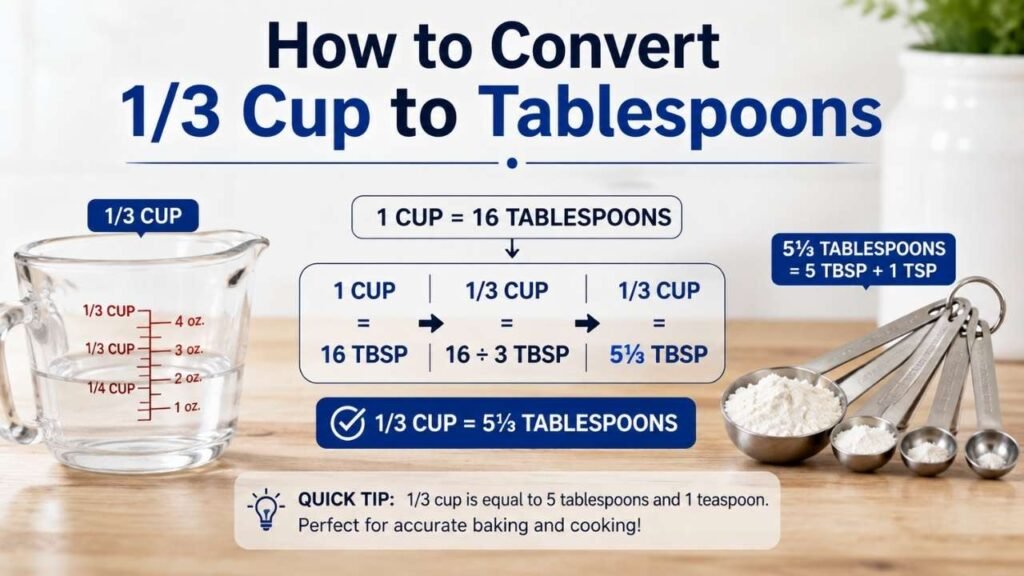
Converting 1/3 cup to tablespoons is easy when you know the basic kitchen measurement rule. One US cup contains 16 tablespoons, so you only need to divide 16 by 3 to find the amount in one-third of a cup.
Here is the simple formula:
16 ÷ 3 = 5.33 tablespoons, or exactly 5⅓ tablespoons.
Since one tablespoon contains three teaspoons, the remaining one-third of a tablespoon equals one teaspoon. Therefore, 1/3 cup equals five tablespoons plus one teaspoon.
You can use this same formula for other US cup measurements. Multiply the number of cups by 16 to convert cups into tablespoons. This method makes recipe conversions quick and easy.
How to Measure 1/3 Cup Without a Measuring Cup
You do not need a special measuring cup to measure 1/3 cup. A regular set of measuring spoons works well and can help you follow recipes when your kitchen tools are limited.
Start by measuring five level tablespoons of your ingredient. Then add one level teaspoon. Together, these measurements equal one-third of a US cup.
For dry ingredients such as flour or sugar, avoid packing the ingredient into the spoon unless the recipe specifically asks for it. Level the top for a more consistent measurement. For liquids, fill each spoon carefully without spilling. If you bake often, a kitchen scale can also help you measure ingredients by weight, provided you use the correct gram conversion for each ingredient.
1/3 Cup Conversion Chart
A conversion chart is useful when you need to adjust a recipe or check another cup measurement quickly. The table below shows common US cup-to-tablespoon conversions, including teaspoons for smaller amounts.
| Cup measurement | Tablespoons | Teaspoons |
| 1/8 cup | 2 | 6 |
| 1/4 cup | 4 | 12 |
| 1/3 cup | 5⅓ | 16 |
| 1/2 cup | 8 | 24 |
| 2/3 cup | 10⅔ | 32 |
| 3/4 cup | 12 | 36 |
| 1 cup | 16 | 48 |
These values follow the standard US measurement system. The most important conversion to remember is 1/3 cup = 5 tablespoons + 1 teaspoon.
Save this chart or keep it nearby when cooking, baking, or scaling recipes. It can save time when you need a quick answer without doing the math again.
What Is 1/3 Cup in Teaspoons, Milliliters, and Fluid Ounces?
Besides tablespoons, you may need to convert 1/3 cup into teaspoons, milliliters, or fluid ounces. These measurements are especially helpful when using recipes from different countries or working with kitchen tools that show different units.
For a standard US cup, the conversions are:
- Tablespoons: 5 tablespoons plus 1 teaspoon
- Teaspoons: 16 teaspoons
- Milliliters: Approximately 79 mL
- US fluid ounces: Approximately 2.67 fluid ounces
Keep in mind that these are volume measurements. A fluid ounce measures volume, while a regular ounce can refer to weight. They are not interchangeable when measuring ingredients.
For everyday cooking, five tablespoons plus one teaspoon is usually the easiest method. If your recipe uses metric units, check which cup size it follows before converting.
Does 1/3 Cup Measure the Same for Dry and Liquid Ingredients?
Yes. One-third cup has the same volume whether you measure flour, sugar, water, milk, or oil. In the US measurement system, it remains equal to five tablespoons plus one teaspoon.
However, the weight in grams will differ because ingredients have different densities. For example, one-third cup of flour does not weigh the same as one-third cup of water or granulated sugar. This is why a single gram value cannot be used for every ingredient.
For most everyday recipes, measuring spoons are useful for checking volume. If a baking recipe gives measurements in grams, use an ingredient-specific conversion or a kitchen scale for better accuracy. This is especially helpful when making bread, cakes, and other recipes where small measurement changes can affect the final result.
FAQs
How many teaspoons are in 1/3 cup?
There are 16 teaspoons in 1/3 US cup. Since one tablespoon contains three teaspoons, five tablespoons plus one teaspoon gives you the correct amount.
Is 5 tablespoons the same as 1/3 cup?
No. Five tablespoons are slightly less than one-third of a US cup. You need one additional teaspoon to reach the correct volume.
How many tablespoons are in 2/3 cup?
Two-thirds of a US cup equals 10 tablespoons plus 2 teaspoons, or approximately 10.67 tablespoons.
Is 1/3 cup approximately 80 mL?
Yes. One-third of a US cup is approximately 79 mL, which is often rounded to 80 mL for everyday cooking. For precise baking, use the measurement system specified in your recipe.
How many grams are in 1/3 cup?
The weight depends on the ingredient. Flour, sugar, butter, and water all have different weights for the same volume, so check an ingredient-specific conversion when grams are needed.
Conclusion
Knowing how many tablespoons are in 1/3 cup makes cooking and baking easier, especially when you do not have every measuring cup available. The simple answer is 5 tablespoons plus 1 teaspoon, which equals approximately 5.33 tablespoons in the US measurement system.
You can use this conversion for both dry and liquid ingredients, but remember that their weights in grams will differ. When a recipe requires precise weight measurements, use a kitchen scale and the correct ingredient conversion.
Keep the conversion chart handy for other common measurements, too. Once you remember that one US cup contains 16 tablespoons, converting fractions such as 1/4 cup, 1/2 cup, and 3/4 cup becomes much easier. With these simple tips, you can measure ingredients confidently and spend more time enjoying your cooking.