
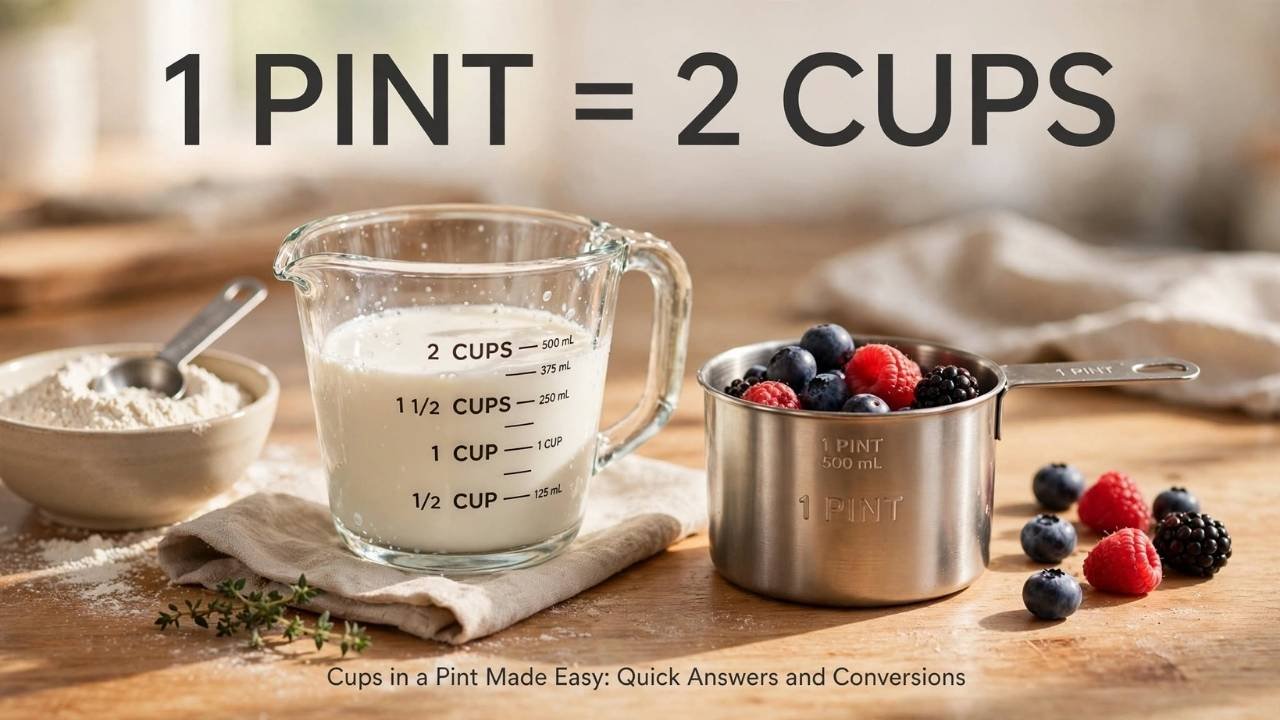
If you are following a recipe and wondering about cups in a pint, the answer is simple. In the US customary system, 1 liquid pint equals 2 cups. This common kitchen conversion can help when a recipe uses pints but you only have measuring cups available.
Knowing how to convert pints to cups is useful for cooking, baking, and everyday recipe measurements. You may also need to convert cups back to pints, or check related measurements such as fluid ounces and milliliters. The measurement can also vary between US and Imperial pints, so it is important to know which system a recipe uses.
In this guide, you will learn how many cups are in a pint, how to make quick pint-to-cup conversions, and how pints compare with cups, ounces, quarts, and gallons. We will also cover liquid and dry pints in simple terms.
Quick Answer
In the US customary system, 1 liquid pint equals 2 cups. So, if a recipe calls for 1 pint, you need 2 cups. One pint also equals 16 fluid ounces or about 473 milliliters. For quick conversions, simply multiply the number of pints by 2 to get cups. For example, 2 pints equal 4 cups, while ½ pint equals 1 cup.
How Many Cups Are in 1 Pint?
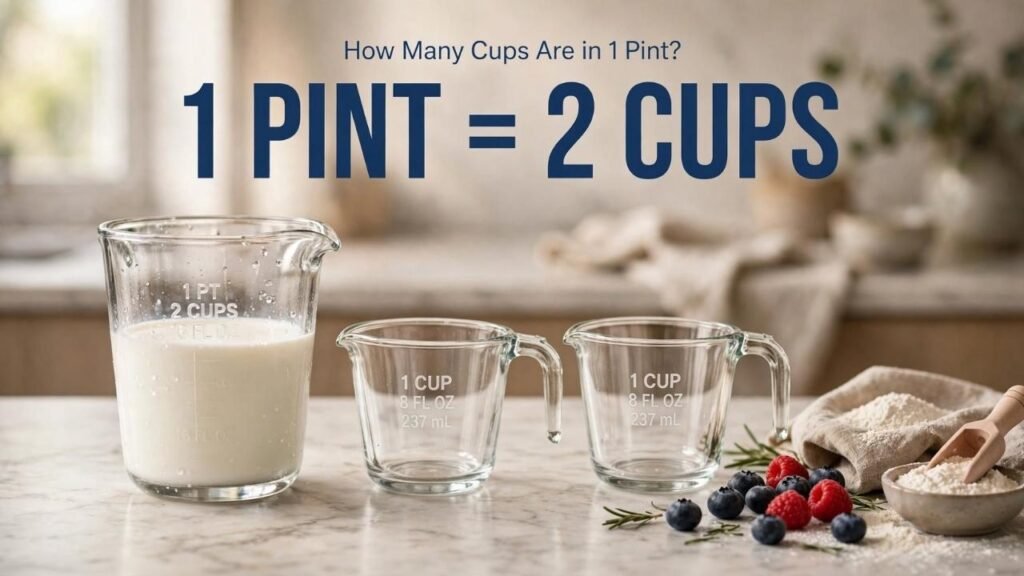
For most everyday recipes in the US customary system, 1 liquid pint equals 2 cups. This is the main conversion to remember when working with kitchen measurements. If a recipe asks for 1 pint of milk, water, cream, or another liquid, you can measure 2 cups instead.
A pint also contains 16 fluid ounces, while 1 cup contains 8 fluid ounces. This makes the conversion easy to understand. You can use the same rule for larger amounts. For example, 2 pints equal 4 cups, 3 pints equal 6 cups, and 4 pints equal 8 cups.
Remember that this simple rule applies to a US liquid pint. Other measurement systems, such as the Imperial system, use a different pint size. Always check the measurement system when following recipes from another country.
Quick Pint-to-Cup Conversion Chart
A pint-to-cup conversion chart makes kitchen measurements much easier. Instead of doing the math each time, you can quickly check the amount you need. For US liquid measurements, the basic rule is simple: 1 pint = 2 cups.
From there, you can double the number of pints to find the number of cups. For example, ½ pint equals 1 cup, while 1½ pints equals 3 cups. This chart is useful when changing a recipe or measuring ingredients without a pint container.
| Pints | Cups |
| ¼ pint | ½ cup |
| ½ pint | 1 cup |
| 1 pint | 2 cups |
| 1½ pints | 3 cups |
| 2 pints | 4 cups |
| 3 pints | 6 cups |
| 4 pints | 8 cups |
| 5 pints | 10 cups |
This simple table can help with quick pints to cups conversions.
How to Convert Pints to Cups
Learning how to convert pints to cups is very simple. For US liquid measurements, you only need one basic formula: Pints × 2 = Cups. In other words, take the number of pints in your recipe and multiply it by two. For example, if a recipe needs 2 pints, multiply 2 by 2 to get 4 cups. If it calls for 3 pints, multiply 3 by 2 to get 6 cups.
The same rule works with fractions. Half a pint is 0.5 pint, so 0.5 × 2 gives 1 cup. A quarter pint equals ½ cup. This pint-to-cup conversion is helpful for cooking, baking, and everyday recipe measurements. Just remember that the formula is based on a US liquid pint. If you are using an Imperial pint, the conversion will be different.
How to Convert Cups to Pints
You can also convert cups to pints when a recipe gives you a cup measurement but you want to know the amount in pints. The basic formula is just the reverse of the pint conversion: Cups ÷ 2 = Pints. For example, 2 cups divided by 2 equals 1 pint. If you have 4 cups, divide 4 by 2 to get 2 pints. Six cups equal 3 pints, while 8 cups equal 4 pints.
You can also use this method with smaller amounts. One cup equals ½ pint, and ½ cup equals ¼ pint. This simple cup-to-pint conversion can be useful when changing recipe amounts or working with different measuring tools.
As with pints to cups, this rule applies to the US liquid measurement system. For recipes using another system, check the measurement standard first.
How Many Ounces Are in a Pint?
A US liquid pint contains 16 fluid ounces. This gives you another easy way to understand the relationship between pints, cups, and ounces. Since 1 cup contains 8 fluid ounces, two cups add up to 16 fluid ounces, which is the same as 1 pint. So the basic relationship is 1 pint = 2 cups = 16 fluid ounces. This can be helpful when a recipe gives you an amount in ounces instead of cups or pints.
For example, ½ pint equals 8 fluid ounces, which is also 1 cup. It is important to use the word fluid ounces when talking about liquid volume. Fluid ounces measure volume, while regular ounces can refer to weight. These are not always the same thing. When converting liquids in a recipe, use fluid ounces to get the correct pint-to-cup conversion.
How Many Milliliters Are in a Pint?
If you use metric measurements, you may want to know how many milliliters are in a pint. One US liquid pint is about 473 milliliters (mL). The word “about” is useful because the US pint does not convert to a whole number of milliliters. For simple cooking, you can usually remember 1 pint ≈ 473 mL. This means ½ pint is about 237 mL, while 2 pints are about 946 mL.
You may also see recipes that use liters or milliliters instead of cups and pints, especially in countries that follow the metric system. When converting recipes, it is helpful to keep the measurement system in mind. The US pint is different from the Imperial pint, so the milliliter amount can change. For everyday US recipes, however, 473 mL per pint is the useful conversion to remember.
Cups, Pints, Quarts, and Gallons Explained
Cups, pints, quarts, and gallons are all common US liquid volume measurements. Knowing how they connect can make recipe conversions much easier. The basic order is cups → pints → quarts → gallons. There are 2 cups in 1 pint, 2 pints in 1 quart, and 4 quarts in 1 gallon. This means 1 quart contains 4 cups, while 1 gallon contains 16 cups.
You can also remember that 1 gallon equals 8 pints. These relationships are useful when changing the size of a recipe. For example, if you have 2 quarts of liquid, that equals 4 pints or 8 cups.
Keeping a simple conversion chart nearby can save time when cooking or baking. Just remember that these relationships describe the US customary liquid system, not every measurement system used around the world.
US Pint vs. Imperial Pint: What’s the Difference?
A US pint and an Imperial pint are not the same size. This is important when using recipes from different countries. A US liquid pint contains 16 US fluid ounces, while an Imperial pint contains 20 Imperial fluid ounces.
Because the pint sizes are different, you should not assume that one US pint and one UK pint hold the same amount. This can cause confusion when following international recipes. The US liquid pint is about 473 mL, while an Imperial pint is about 568 mL. The cup used in the calculation also matters, so always check the measurement system before converting.
If a US recipe says 1 pint, you can normally use 2 US cups. For a British or other Imperial recipe, use the correct Imperial measurements instead. Checking the recipe’s country can help you avoid a simple but important measurement mistake.
Liquid Pint vs. Dry Pint
A liquid pint and a dry pint are different types of measurements. A liquid pint is used to measure volume, especially for liquids such as water, milk, juice, and broth. A dry pint is used for some dry foods and produce. While both use the word “pint,” they do not always represent the same amount.
This is why you should be careful when a recipe mentions a pint of a dry ingredient. For liquids, the common US conversion is 1 liquid pint = 2 cups. Dry ingredients can be affected by how they are packed, shaped, or measured, so their volume and weight may vary.
A dry pint also should not automatically be treated as the same as a liquid pint. If a recipe gives a dry ingredient by pint, follow the recipe’s measurement instructions carefully rather than assuming the standard liquid conversion.
Does 1 Pint Always Equal 2 Cups?
No, 1 pint does not always equal 2 cups in every measurement system. For the standard US liquid measurement, 1 pint equals 2 US cups. This is the conversion most people need for everyday American recipes. However, other countries may use different pint and cup sizes. The Imperial pint, for example, is larger than the US pint.
This means an international recipe may not give the same result if you automatically use the US conversion. The type of measurement also matters. A liquid pint and a dry pint should not be treated as identical without checking the context.
When you see a pint in a recipe, first ask which measurement system the recipe uses. If it is a standard US liquid recipe, you can safely remember the simple rule: 1 pint = 2 cups. For other systems, check the correct conversion before measuring.
Common Recipe Conversions From Pints to Cups
Pint measurements often appear in recipes for soups, sauces, drinks, dairy products, and other foods. Knowing a few common conversions can make cooking much easier. For a US liquid pint, use the rule 1 pint = 2 cups. This means ½ pint equals 1 cup, while 1½ pints equal 3 cups. If a recipe calls for 2 pints, you need 4 cups.
Three pints equal 6 cups, and 4 pints equal 8 cups. You can also convert smaller amounts. A quarter pint equals ½ cup, while 2½ pints equal 5 cups. These quick examples are useful when you want to adjust a recipe or use measuring cups instead of a pint container.
Always remember that these values apply to US liquid pints. If the recipe comes from a country using Imperial measurements, check the measurement system before making the conversion.
Can You Measure a Pint With a Measuring Cup?
Yes, you can measure a US liquid pint with a measuring cup. Since 1 liquid pint equals 2 cups, simply measure two cups of the liquid. For the best results, use a liquid measuring cup when measuring water, milk, broth, oil, or similar ingredients.
Liquid measuring cups usually have a clear scale that lets you check the amount at eye level. This can help improve accuracy. If you are measuring dry ingredients, use the type of measuring cup recommended by the recipe.
Dry ingredients should usually be filled and leveled rather than measured like a liquid. It is also important not to confuse fluid ounces with weight ounces. A measuring cup measures volume, while a kitchen scale measures weight. Using the right tool can make your recipe more accurate. For a simple liquid pint, however, the rule remains easy: 2 cups = 1 pint.
Common Mistakes When Converting Pints to Cups
Pint-to-cup conversions are simple, but a few common mistakes can lead to wrong results. The first is confusing a US pint with an Imperial pint. They are different sizes, so always check the measurement system. Another mistake is confusing fluid ounces with weight ounces.
A liquid pint contains 16 fluid ounces, but that does not mean every pint of food weighs 16 ounces. The ingredient’s density affects its weight. Some people also treat a dry pint and liquid pint as exactly the same measurement, which can cause problems with certain ingredients.
Another mistake is using the wrong measuring tool. Use a liquid measuring cup for liquids and suitable measuring tools for dry ingredients. Finally, do not rely on a general rule when a recipe gives a specific measurement system. For most US liquid recipes, the simple answer is still 1 pint = 2 cups.
Cups in a Pint for Common Ingredients
When a recipe gives a pint of a liquid ingredient, the volume conversion stays the same. For example, 1 US liquid pint of water equals 2 cups, and the same volume rule applies to milk, cream, broth, juice, and many other liquids. So, if a soup recipe asks for 1 pint of broth, you can measure 2 cups of broth instead.
If a dessert recipe needs 1 pint of cream, you can also use 2 cups. However, the weight of each ingredient can be different because ingredients have different densities. A pint of water will not weigh exactly the same as a pint of oil, cream, or another ingredient.
This is why volume and weight should not be mixed up. When a recipe gives a pint measurement, focus on volume unless it also provides a weight measurement. For simple liquid recipes, remember: 1 pint = 2 cups.
FAQs
How many cups are in 1 pint?
There are 2 cups in 1 US liquid pint.
How many cups are in half a pint?
½ pint equals 1 cup in the US liquid system.
How many cups are in 2 pints?
2 pints equal 4 cups.
How many ounces are in a pint?
A US liquid pint contains 16 fluid ounces.
How many milliliters are in a pint?
One US liquid pint is about 473 mL.
Is a US pint the same as a UK pint?
No. A UK Imperial pint is larger than a US liquid pint.
Is a dry pint the same as a liquid pint?
No. Dry and liquid pints are used in different measurement contexts.
How do I convert pints to cups?
Multiply the number of US liquid pints by 2.
How do I convert cups to pints?
Divide the number of US cups by 2.
Can I measure a pint with cups?
Yes. For a US liquid pint, measure 2 cups.
Conclusion
The easiest answer to remember is 1 US liquid pint = 2 cups. You can also think of it as 1 pint = 16 fluid ounces ≈ 473 mL. To convert pints to cups, multiply by 2. To convert cups to pints, divide by 2. For example, 2 pints equal 4 cups, while ½ pint equals 1 cup.
These conversions are useful for cooking, baking, and changing recipe measurements. However, always check whether a recipe uses US or Imperial measurements, because pint sizes can differ.
You should also pay attention to the difference between liquid and dry measurements. When working with common US recipes, though, the key rule is simple and easy to remember: two cups make one pint. Keeping this basic conversion in mind can make many kitchen measurements faster and less confusing.