
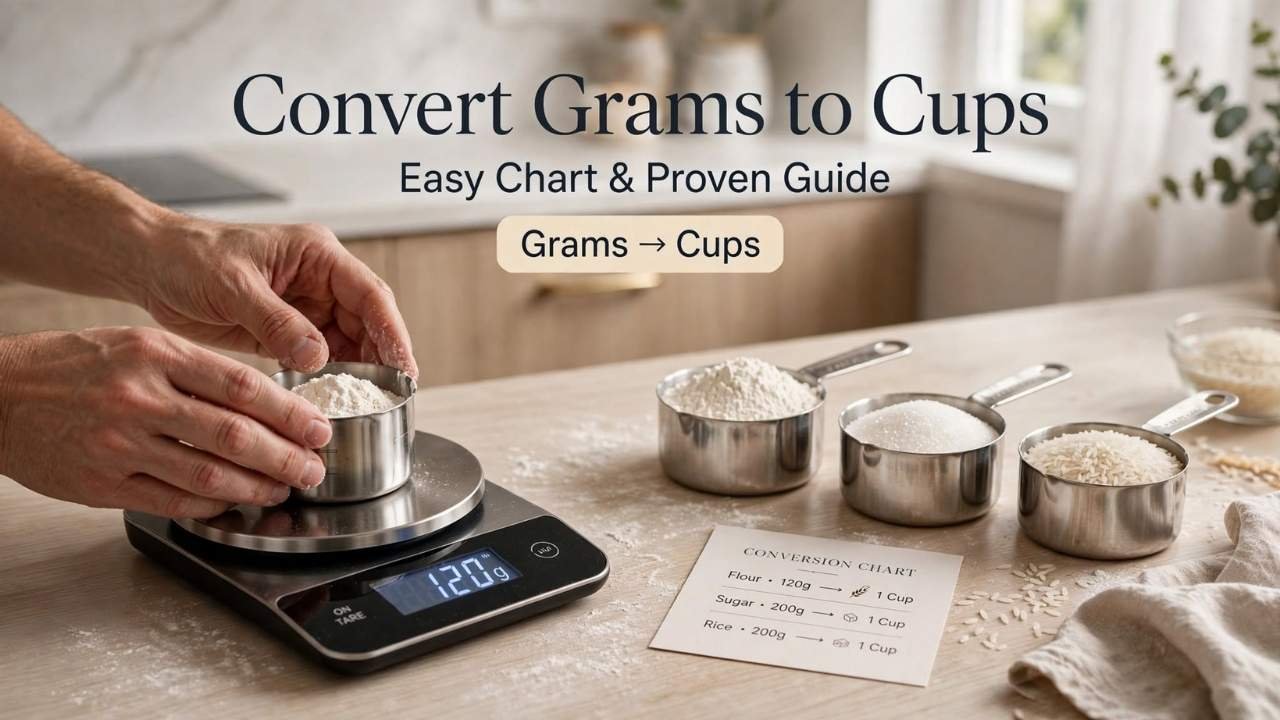
Converting grams to cups can be confusing because grams measure weight, while cups measure volume. There is no single conversion that works for every ingredient. For example, 100 grams of flour will take up a different amount of space than 100 grams of honey or butter.
The right grams to cups conversion depends mainly on the ingredient’s density and the cup measurement being used.In this guide, you’ll learn how to convert grams to cups with simple formulas, practical examples, and easy conversion charts.
You’ll also find common grams to cups measurements for flour, sugar, butter, milk, water, honey, oil, oats, rice, and other ingredients. Whether you are following a baking recipe or need a quick grams to cups conversion chart, this guide will help you get an accurate answer without unnecessary confusion.
Quick Answer
To convert grams to cups, you need to know the ingredient because grams measure weight, while cups measure volume. There is no universal grams-to-cups conversion. For example, 100 grams of flour takes up a different volume than 100 grams of sugar or honey. Use an ingredient-specific conversion chart or divide the grams by the ingredient’s grams-per-cup value for a quick and practical result.
Grams to Cups Conversion Chart
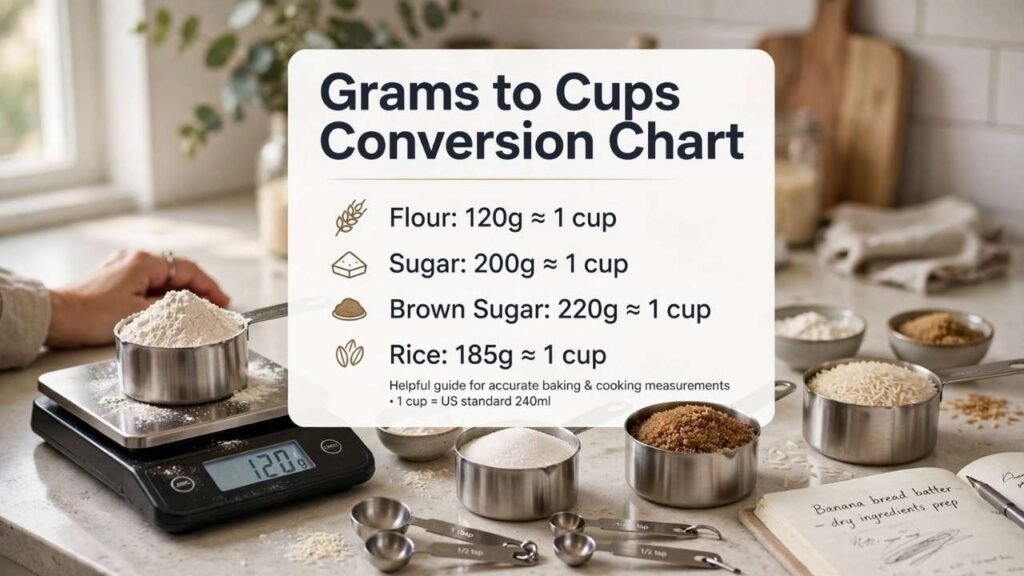
A grams to cups conversion chart makes cooking and baking much easier when a recipe uses weight instead of volume. However, remember that the correct amount depends on the ingredient. For example, 100 grams of flour will not fill the same part of a cup as 100 grams of honey.
This is because each ingredient has a different density. For this reason, an ingredient-specific chart is more useful than one universal conversion.
Common ingredients that can be converted include flour, sugar, butter, milk, water, honey, oil, rice, oats, and cocoa powder. You can also find common amounts such as 50 grams, 100 grams, 150 grams, 200 grams, 250 grams, and 500 grams. Always check whether the chart uses a US cup or metric cup before using the result.
How Many Cups Is 100 Grams?
The answer to 100 grams to cups depends on the ingredient you are measuring. There is no fixed number because grams measure weight, while cups measure volume. For example, 100 grams of flour takes up more space than 100 grams of honey because honey is much denser. The same idea applies to sugar, butter, oats, rice, and other ingredients.
When a recipe asks for 100 grams, first identify the ingredient and then use its specific grams-per-cup value.For baking, this step is especially important because even a small difference can affect the final result.
If you do not have a kitchen scale, an ingredient-specific grams to cups chart can give you a useful estimate. For the most accurate result, however, weighing the ingredient in grams is usually the better choice.
How Many Cups Is 200 Grams?
If you need to convert 200 grams to cups, you must first know which ingredient you are using. Two hundred grams of flour, sugar, butter, or honey will produce different cup measurements. This happens because each ingredient has its own density and weight per cup.
To get the right answer, find the ingredient in a reliable grams to cups conversion chart and check its grams-per-cup value. You can also use the basic formula by dividing 200 grams by the number of grams in one cup of that ingredient.
For example, if an ingredient weighs 100 grams per cup, 200 grams would equal 2 cups. This simple method works for many cooking and baking ingredients. Always check the cup size and measuring method used by your recipe before making the conversion.
How Many Cups Is 250 Grams?
When converting 250 grams to cups, the ingredient matters more than the number itself. A cup of flour does not weigh the same as a cup of sugar, butter, or honey. Therefore, 250 grams will produce a different volume for each ingredient. Start by identifying the ingredient and finding its grams-per-cup measurement.
Then divide 250 by that value to find the number of cups. If you are using a recipe from another country, also check whether it uses a US cup or metric cup, as cup sizes can differ. For home cooking, a conversion chart gives a quick estimate and saves time.
For baking, using a digital kitchen scale is usually more accurate. If a recipe gives the weight in grams, keeping the measurement in grams can help you get a more consistent result.
How Many Cups Is 500 Grams?
Converting 500 grams to cups works the same way as smaller amounts, but the answer still depends on the ingredient. Five hundred grams of flour will not equal the same number of cups as 500 grams of sugar, butter, or water.
This is because ingredients have different densities. To make the conversion, find how many grams are in one cup of your ingredient and divide 500 by that number. A grams to cups calculator can also make this process faster.
When working with large amounts, small measuring errors can become more noticeable, especially in baking. For this reason, a kitchen scale is a good choice when accuracy matters. If you are using a chart, make sure it uses the same ingredient type, cup standard, and measuring method as your recipe for the most useful result.
Grams to Cups for Common Ingredients
Different ingredients need different grams to cups conversions. This is one of the most important things to remember when using a conversion chart. Common baking ingredients such as all-purpose flour, granulated sugar, brown sugar, powdered sugar, and butter have different weights per cup. The same is true for liquids and other foods, including milk, water, honey, oil, oats, rice, and cocoa powder.
Ingredients can also change slightly depending on how they are measured. Flour, for example, can become more compact when it is scooped directly from a container. Brown sugar is often packed into the cup, while powdered ingredients may be sifted.
Because of these differences, always choose the conversion that matches the ingredient and preparation method. This approach gives you a more useful answer than using one universal grams to cups formula.
Grams to Cups of Flour
Grams to cups of flour is one of the most common kitchen conversions because many baking recipes use flour by weight. However, flour can be difficult to measure by volume because it can become packed inside a measuring cup. All-purpose flour, bread flour, cake flour, whole wheat flour, almond flour, and oat flour can also have different weights per cup.
For this reason, avoid assuming that one flour has the same conversion as another. When using cups, the spoon-and-level method is often preferred for a more consistent measurement. This means gently spooning flour into the cup and leveling the top without pressing it down.
A kitchen scale is still the best option when a recipe provides flour in grams. If you need a quick conversion, use a chart made specifically for the type of flour you are measuring.
Grams to Cups of Sugar
The grams to cups sugar conversion depends on the type of sugar and how it is measured. Granulated sugar, brown sugar, powdered sugar, and caster sugar do not always have the same weight per cup. Brown sugar is often measured while packed, which means more sugar fits into the same cup. Powdered sugar is much lighter and can also be affected by sifting.
Because of these differences, using the correct ingredient-specific conversion is important. If a recipe says 100 grams of sugar, do not automatically replace it with one-half cup without checking the type of sugar.
For the best result, follow the recipe’s measurement method and use a kitchen scale when possible. If you only have measuring cups, choose a reliable grams to cups chart that clearly explains whether the sugar is packed, loose, or sifted.
Grams to Cups of Butter
Converting grams to cups of butter is often easier than converting flour because butter is fairly consistent when measured. Still, you should use the weight given on the package or a reliable butter conversion chart. Butter is commonly sold in sticks or blocks, so recipes may give measurements in grams, cups, tablespoons, or sticks.
If your recipe lists grams, weighing the butter is the most direct method. If you only have cups, you can use the grams-per-cup value for butter to make the conversion. Remember that melted butter and solid butter should not always be treated as identical measurements because the recipe may be written for one specific form.
Before converting, check whether the recipe asks for melted, softened, or solid butter. This small detail can help prevent measurement mistakes in baking.
Grams to Cups of Milk
When converting grams to cups of milk, the process is different from converting dry ingredients such as flour. Milk is a liquid, so it can be measured by volume, but its weight is not exactly the same as water. If your recipe gives milk in grams, you can use a milk-specific conversion chart or calculate the volume using its weight per cup.
For everyday cooking, a small difference may not matter much. In baking, however, accurate measurements can help keep the recipe balanced. Use a liquid measuring cup when measuring milk by volume rather than a dry measuring cup.
Also check whether your recipe uses a US cup or metric cup. If you frequently follow recipes that use grams, keeping a kitchen scale nearby can make conversions much easier and reduce the need to estimate liquid amounts.
Grams to Cups of Water
Water is one of the simplest ingredients to convert because its weight and volume have a close relationship. However, the exact cup result can still depend on the measurement system being used. A US cup and a metric cup are not exactly the same size, so always check the recipe’s standard.
If a recipe gives water in grams, you can usually make a quick conversion using a suitable water chart. For example, a recipe may use grams because it was written with a kitchen scale in mind, while a home cook may prefer cups or milliliters.
Unlike flour or honey, water does not have the same large density differences found in many ingredients. Still, it is best to follow the measurement system used by the recipe. For precise baking, keeping water in grams can provide a simple and consistent result.
Grams to Cups of Honey
The grams to cups of honey conversion is very different from flour because honey is much denser. This means a certain weight of honey takes up less space than the same weight of many dry ingredients. If a recipe calls for 100 grams of honey, do not assume that it equals the same cup amount as 100 grams of flour or sugar.
Use a honey-specific conversion chart or divide the grams by honey’s grams-per-cup value. Honey can also stick to measuring cups, which may make volume measurement less convenient.
A useful kitchen tip is to lightly coat the measuring cup with a small amount of oil before adding honey, when suitable for the recipe. This can help the honey slide out more easily. For accurate baking, measuring honey by weight in grams is often simpler and more consistent.
Grams to Cups of Oil
To convert grams to cups of oil, you need to consider the type of oil because different oils can have slightly different densities. Common examples include vegetable oil, olive oil, coconut oil, and other cooking oils.
A grams-to-cups calculator may give different results depending on the oil selected. This is why choosing the correct ingredient before converting is important. If your recipe gives oil in grams, use the oil’s specific conversion rather than a general liquid conversion.
For everyday cooking, a small difference may not be important, but accurate measurements can matter in baking and sauces. Also check whether the recipe calls for oil in its liquid or solid form, especially with coconut oil. Using an ingredient-specific chart helps avoid confusion and gives you a more reliable estimate when converting cooking measurements from grams to cups.
Grams to Cups of Oats, Rice, and Cocoa Powder
Ingredients such as oats, rice, and cocoa powder also need their own grams-to-cups conversions. These ingredients can have different weights because of their shape, particle size, and how closely they settle in a measuring cup.
For example, rolled oats contain more empty space than a fine powder, while rice grains settle differently from both oats and cocoa. This is why you should not use a flour conversion for these ingredients.
If a recipe gives 100 grams of oats, rice, or cocoa powder, look for the specific ingredient in a conversion chart. Measuring by weight is especially helpful when making baked goods with cocoa powder because small changes can affect the recipe’s balance. When using cups, avoid pressing or shaking ingredients into the cup unless the recipe specifically tells you to do so.
Why Can’t You Convert Grams to Cups Without Knowing the Ingredient?
You cannot make a reliable grams to cups conversion without knowing the ingredient because grams and cups measure different things. Grams measure weight or mass, while cups measure volume. The link between them is the ingredient’s density.
A dense ingredient such as honey can weigh much more than a light ingredient such as flour when both fill the same cup. This is why there is no universal rule such as “100 grams equals one-half cup.” The same weight can produce very different volumes.
This idea is important when using a grams to cups calculator, conversion chart, or recipe converter. Always select the correct ingredient before converting. If the ingredient is not listed, find a trusted grams-per-cup value or density measurement instead of borrowing the conversion for another ingredient.
Grams to Cups Formula
The basic grams to cups formula is simple when you know how many grams are in one cup of the ingredient. The formula is: cups = grams ÷ grams per cup. For example, if an ingredient weighs 125 grams per cup, you would divide the number of grams by 125 to find the cup amount.
This method works because each ingredient has its own weight per cup. You can also use density when a grams-per-cup value is not available, but that method is more technical and usually not needed for everyday cooking.
A grams to cups calculator simply makes this process faster by doing the calculation for you. Before using the formula, confirm the ingredient, cup standard, and measurement method. This helps you avoid errors caused by using the wrong conversion factor.
How to Convert Grams to Cups Manually
You can convert grams to cups manually with a few simple steps. First, identify the exact ingredient you need to measure. Next, find how many grams that ingredient weighs per cup. Then, divide your gram amount by the grams-per-cup value.
For example, if one cup of an ingredient weighs 125 grams and your recipe needs 250 grams, divide 250 by 125 to get 2 cups. The calculation is easy, but the important part is using the correct conversion value.
You should also check whether the recipe uses a US cup or metric cup. For ingredients such as flour and brown sugar, check how the ingredient should be placed into the cup. If accuracy is important, especially for baking, using a digital kitchen scale is usually better than converting the measurement.
Why Do Different Grams-to-Cups Charts Give Different Answers?
You may notice that two websites give slightly different answers for the same grams to cups conversion. This does not always mean that one source is wrong. Different charts may use different ingredient densities, cup sizes, brands, or measuring methods.
Flour is a good example because its weight can change depending on whether it is spooned into a cup, scooped directly, or packed down. Sugar can also vary when brown sugar is packed or left loose. Some sources may use a US cup, while others may use a metric cup.
For this reason, it is important to choose one clear measurement standard and use it consistently. When comparing conversion charts, check the ingredient, cup type, and measuring method before deciding which value to use. This makes your grams to cups calculator or chart easier to trust.
US Cup vs. Metric Cup: Which One Should You Use?
A US cup and a metric cup are not exactly the same size, so this detail matters when converting grams to cups. Most recipes written for a US audience use a US-style cup, while some recipes from other countries may use a metric cup.
There are also other cup standards, including older UK measurements. Because the cup is a volume measurement, changing the cup size can change the final conversion. This is especially important when you are working with precise baking recipes. Before using a grams to cups conversion chart, check which cup standard it follows.
It is also helpful to state the cup standard clearly when writing or sharing a recipe. If your recipe comes from another country, follow its original measurement system whenever possible. This simple check can prevent unexpected differences in your results.
How Ingredient Preparation Changes the Conversion
The way an ingredient is prepared can change its grams-to-cups conversion. Flour is one of the best examples. If you scoop flour directly from a container, it may become more compact and add more flour to the cup.
The spoon-and-level method usually gives a lighter and more controlled measurement. Brown sugar is different because recipes often ask you to pack it firmly into the cup. Powdered sugar may be sifted before measuring, which can change its volume. These small details explain why two people can use the same cup but end up with different weights.
When using a conversion chart, check whether the ingredient is packed, sifted, or loose. If the recipe provides grams, you can avoid many of these problems by weighing the ingredient. This is one reason weight-based measurements are popular in baking.
Grams vs. Cups: Which Is More Accurate?
When accuracy matters, grams are usually more consistent than cups, especially for baking. A kitchen scale measures the actual weight of an ingredient, while a cup measurement can change depending on how the ingredient is placed inside the cup.
Flour, for example, can become packed when scooped, leading to more flour than intended. Using grams removes much of this guesswork. Cups are still useful for everyday cooking, especially when a recipe is already written in volume measurements.
The best choice depends on the recipe and the level of accuracy you need. If you are making bread, cakes, pastries, or other recipes where ingredient balance matters, a digital kitchen scale can be very helpful. If you only need a quick estimate, a reliable grams to cups chart can work well. Always follow the recipe’s preferred measurement method when possible.
How to Convert a Recipe From Grams to Cups
To convert a recipe from grams to cups, convert each ingredient separately. Do not use one universal grams-to-cups ratio for the entire recipe. Start by making a list of every ingredient and identify its correct grams-per-cup value. Then divide each weight by that ingredient’s value.
For example, flour, sugar, butter, and milk will each need their own conversion. Keep the same cup standard throughout the recipe so the measurements remain consistent. You should also pay attention to ingredients that are packed, sifted, melted, or prepared in another way.
Avoid rounding numbers too early because small changes can add up in a recipe. If the original recipe gives weights in grams, keeping the recipe in grams is often the easiest and most accurate choice. Cups are best used when a scale is not available.
How to Convert an Ingredient That Isn’t on the Chart
Sometimes you may need to convert an ingredient that does not appear in a standard grams to cups conversion chart. You can still find the answer, but you need the ingredient’s grams-per-cup value or reliable density information. First, identify the exact ingredient and its form.
Then find a trusted measurement source that gives its weight per cup. Once you have that number, use the formula cups = grams ÷ grams per cup. Do not use the conversion for a similar-looking ingredient because small density differences can change the result.
This is especially important for specialty flours, powders, seeds, and thick ingredients. If accurate measurement is important, use a kitchen scale instead of trying to estimate the volume. A scale gives you the actual weight and removes much of the uncertainty caused by different measuring methods.
Common Grams-to-Cups Conversion Mistakes
Several common mistakes can make a grams to cups conversion less accurate. The first is assuming that every ingredient has the same conversion. They do not. Another mistake is confusing grams with milliliters, since grams measure weight while milliliters measure volume. Using the wrong cup standard can also change the result.
Flour creates another common problem because scooping it directly into a cup can pack it down. Brown sugar may need to be packed when the recipe calls for it. People also sometimes mix values from different conversion charts, even though the charts may use different cup sizes or ingredient densities.
Finally, rounding too much can affect recipes that need precise measurements. To avoid these problems, identify the ingredient, use one reliable chart, check the cup standard, and use a kitchen scale when accuracy matters.
Grams to Cups vs. Grams to Milliliters
Grams, milliliters, and cups are different types of measurements. Grams measure mass or weight, while milliliters and cups measure volume. Because of this, 100 grams does not always equal 100 milliliters. Water is a useful example because its weight and volume have a close relationship, but many other ingredients are different. Honey, oil, flour, and sugar all have different densities.
This means you cannot simply replace grams with milliliters and expect the same result. Cups and milliliters can be converted because both measure volume, while grams require information about the ingredient’s density.
When a recipe gives an ingredient in grams, use a suitable grams to cups conversion for that ingredient rather than treating grams and milliliters as identical. Understanding this difference makes cooking conversions much easier and helps prevent common measurement mistakes.
Quick Grams-to-Cups Reference Table
A quick grams-to-cups reference table can save time when you are cooking or baking. However, the table should always be organized by ingredient because there is no universal conversion. Useful gram amounts include 10 g, 25 g, 50 g, 75 g, 100 g, 125 g, 150 g, 200 g, 250 g, 300 g, 400 g, 500 g, 750 g, and 1,000 g.
You can then provide separate values for common ingredients such as flour, sugar, butter, water, milk, honey, oil, rice, oats, and cocoa powder. This approach is much more useful than writing one number for every ingredient. If you use a conversion chart, check the cup standard and measuring method before applying the numbers to a recipe.
For precise baking, remember that a kitchen scale is still the most reliable option when the original recipe provides measurements in grams.
FAQs
How many cups is 100 grams?
It depends on the ingredient. Flour, sugar, butter, and honey have different weights per cup, so 100 grams will not equal the same volume for each one.
How many cups is 200 grams?
The answer depends on the ingredient’s grams-per-cup value. Use an ingredient-specific conversion chart for the most useful result.
How many cups is 250 grams?
You need to know the ingredient first. 250 grams of flour will produce a different cup measurement from 250 grams of sugar or honey.
How many cups is 500 grams?
There is no universal answer. Divide 500 grams by the ingredient’s grams-per-cup value.
How many grams are in one cup?
The answer depends on what is inside the cup. One cup of flour does not weigh the same as one cup of sugar, butter, or honey.
Can I convert grams to cups without a scale?
Yes. You can use a reliable grams to cups chart if you know the exact ingredient.
Conclusion
Learning how to convert grams to cups is simple once you understand that the ingredient matters. Grams measure weight, while cups measure volume, so there is no single conversion that works for every food. Flour, sugar, butter, milk, honey, oil, oats, rice, and cocoa powder all have different weights per cup.
For a quick answer, use an ingredient-specific conversion chart and check whether it uses a US or metric cup. Also pay attention to whether an ingredient is packed, sifted, or measured loosely.
If accuracy is important, especially when baking, a digital kitchen scale is usually the best choice. When you do need to convert manually, use the simple formula: cups = grams ÷ grams per cup. With these tips, you can handle most cooking and baking measurement conversions with confidence.